





Your company generates a staggering quantity of data each day. You need techniques and tools to transform your data into useful insights if you want to spot issues, make better decisions, and make money. Data management solutions are used to comprehend both historical and current data and generate insights. These solutions include business intelligence (BI), as well as its subset – data analytics. These days, the terms “business intelligence” and “data analytics” are frequently used interchangeably. However, this causes confusion among people, especially newcomers who are unaware of the fundamental distinction between the two phrases that are frequently used in the analytics industry. But in reality, Data Analytics and Business Intelligence vary considerably from one another. Both have distinct areas of responsibility and call for a variety of abilities to enable firms to thrive through data-driven decision-making. To help you decide between Business Intelligence and Data Analytics, this article gives you a thorough review of both concepts and highlights their critical differences.

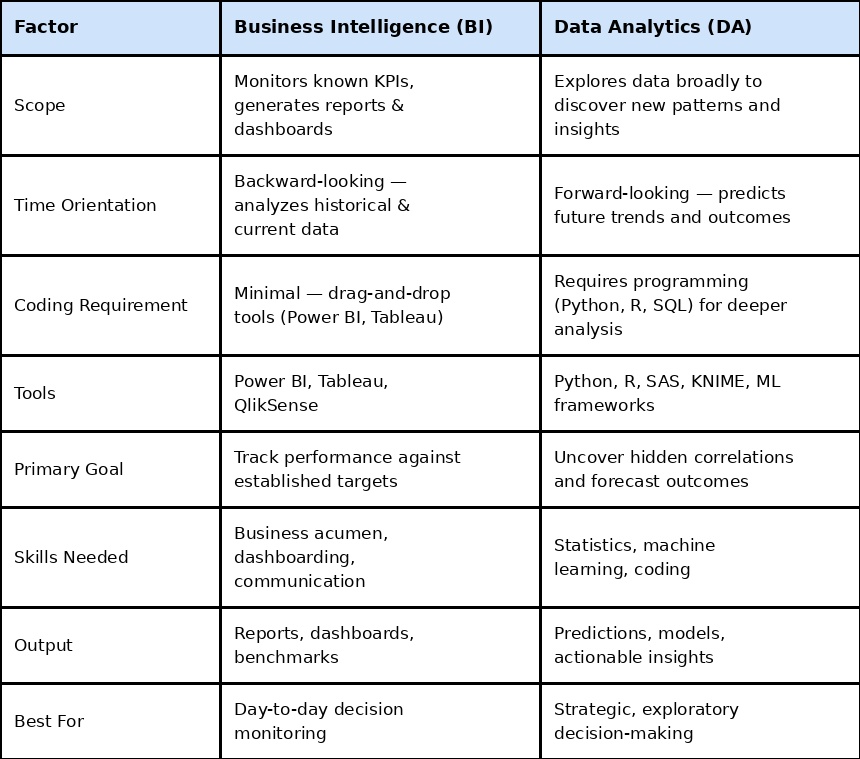
Business Intelligence (BI) focuses on analyzing historical and current data to monitor performance through dashboards and reports, helping teams understand "what happened." Data Analytics goes further using statistical models, coding, and predictive techniques to uncover "why it happened" and forecast "what's likely to happen next." BI is about tracking known metrics; Data Analytics is about discovering new insights.
Business Intelligence
In a book written by a writer by the name of Richard Miller Devens, the word “business intelligence” was first used in 1865. Business intelligence is the knowledge intended to improve business decision-making. Business intelligence is mostly used to improve decision-making and support businesses in growing. Business intelligence can be implemented using several of the BI products available on the market. For BI implementation, only historical data stored in data marts or warehouses are used. BI encourages error-free procedures for verifiable and concrete data. It provides information on the company’s records, which aids officials in assessing the company’s growth both economically and in other areas. BI is far more beneficial than anything else because it gives business professionals the chance to assess the company’s success while reflecting on the mistakes that obstructed the growth process.
- Business Intelligence includes the following tools:
- Real-time monitoring
- Dashboard development and reporting
- Benchmarking
- Implementation of BI software, like Power BI
- Performance management
- Data and text mining
- Data Analytics
This shows how varied business intelligence procedures and duties are. Furthermore, while Data Analytics is a distinct and crucial BI tool, nonetheless it is ultimately simply one component of a much larger picture.
Recommended Reads:
- Data Analyst Skills
- Data Analytics Career
- Data Analyst Interview Questions
- Scope of Data Analytics
- Data Analytics Salary
- Data Analytics For Finance Professionals
- Data Analytics Tools
- Data Analytics Entry-Level Jobs
Advantages of Business Intelligence
Today’s market for business intelligence is extremely competitive since it provides a wide range of advantages. Some of these advantages include:
- Reporting: Businesses may easily produce reports using business intelligence tools to learn fresh information about their existing situation. Organizations can spot trends in a variety of areas, such as operational costs and sales processes.
- Real-Time Insights: Businesses can obtain real-time insights using a variety of business intelligence solutions, enabling them to act promptly and beat out rivals.
- Profit Maximisation: Profit is what business intelligence eventually comes down to. In the end, it prioritizes boosting revenue through enhanced operations. For example, a social media firm could be more interested in using BI to figure out how to increase ad clicks, and a toy company, which might use it to better its Christmas sales strategy. This means that indicators like sales revenue, profit margins, staff attendance, and data from the supply chain are used to determine how an organization operates.
Who is a Business Intelligence analyst?
The art of converting business requirements into the right graphs, charts, spreadsheets, and dashboards is a strength of business intelligence analysts. They frequently collaborate with business users and subject-matter experts who are on the front lines. To transform the raw data into a format that the users are accustomed to, they also require a thorough grasp of business procedures, finance, and accounting.
The technical aspects of dealing with structured databases and data warehouses must be thoroughly understood by BI analysts. They must be skilled at constructing intricate joins between tables and producing intricate SQL queries. It is easier to ensure that they provide reports that reduce database processing overhead when they are familiar with various query optimization strategies.
Read in-depth:
- Data Analytics Jobs
- Data Analyst Qualifications
- Data Analytics For Business
- Data Analytics Trends
- Data Analytics With Python
- Data Analytics Using Power Bi
- Benefits of Data Analytics

Data Analytics
Although data analytics has been present since the 19th century, it gained popularity in the 1960s when computers were first invented. The procedure of gathering, inspecting, purifying, manipulating, storing, modeling, and querying data is known as data analytics. Its objective is to generate insights that guide decision-making in a variety of fields, including business as well as the sciences, government, and education. It is not solely a business intelligence tool but is frequently utilized in a commercial setting. Utilizing different data storage systems on the market, data analytics can be implemented. BI tools can also be used to implement data analytics, although this depends on the strategy or approach chosen by the company.
We may categorize data analytics into four major groups. These are:
1. Descriptive Analytics
Similar to business intelligence techniques, descriptive analytics uses historical data to produce mean, median, and average insights.
2. Diagnostic Analytics
A crucial stage in data analytics is diagnostic analytics, which is concerned with assessing connections between various variables to carry out root cause analysis. Organizations can use diagnostic analytics to identify the variables that are either hindering their operations or contributing the most value.
3. Predictive Analytics
Utilizing predictive analytics, past performance is used to predict future performance. Businesses can change how they do business using data from predictive analytics to potentially change the outcome.
Explore and learn more about:
- Work From Home Data Analytics Jobs
- Data Analytics Techniques
- Data Analytics For Project Management
- Data Analytics vs Data Science
- Data Analytics Services
- Importance of Data Analytics
- Data Analytics Consultant
4. Perspective Analytics
The future can be foreseen using perspective analytics depending on the changes a corporation is ready to adopt. For instance, decision-makers can alter tactics and carry out perspective analytics to comprehend how the outcome can be impacted in the future if a company’s sales are predicted to decline in the upcoming quarter via predictive analytics.
Advantages of Data Analytics:
Data analytics is one of the top rising fields to work in today since it offers a wide range of benefits. Several of these advantages include:
Advanced Insights: By using data analytics, businesses may perform in-depth analyses that help them understand their business operations well. Clear comprehension of corporate procedures helps remove uncertainty from the decision-making process.
Future-ready: Data analytics enables businesses to gather the information that reveals flaws in company procedures, supporting them in making decisions to alter future outcomes.
Who is a Data Analyst?
A data analyst excels in examining large, complicated data sets to find novel patterns that are beneficial to particular business groups. They frequently begin with broad objectives laid out by corporate executives. Then, they’ll invest additional time in the background searching for fresh data sets, sifting through the data for intriguing patterns, and transforming the raw data into fresh data models. To distinguish a promising new data model from raw data, data analysts require a firm grasp of data mining techniques, machine learning, and statistics. They typically possess strong expertise working with raw data utilizing statistical analysis programs like SAS and KNIME as well as R and Python. In the United States, the average base salary for a data analyst is around $75,000–$85,000 per year as of 2026, depending on experience and industry.
You should know about:
- Data Analytics Companies in India
- Data Analytics Examples
- Data Analytics vs Data Mining
- Data Analytics vs Machine Learning
- Data Analytics vs Artificial Intelligence
- Data Analytics For Beginners
- Data Analytics With R
- Data Analytics Books
What distinguishes a Business Intelligence analyst from a Data Analyst?
A data analyst’s tasks include analyzing data for trends and delivering actionable insights. When utilized as a business intelligence tool, these findings are relevant to the business. The value of data analytics has resulted in this, yet data analysts are not usually naturally good at business (although they can be). Instead, they are primarily mathematicians and technical experts who can create algorithms, perform statistical analysis, and write code in programming languages like Python.
The primary areas where business intelligence analysts excel are the administration of strategies, persuasion and communication, leadership, commercial awareness, and other business-related fields. On the other hand, they typically have the requisite technical knowledge.
Data Analytics VS Business Intelligence
A key tool for corporate intelligence is data analytics. It is not, however, the same as business intelligence. Data analytics is probably the most basic business intelligence instrument there is.
Data analytics seeks to approach data objectively on its own. It just cares about responding to the particular query at hand. While in this context it may mean maximizing profit, which is business intelligence’s main objective, data analytics is also utilized in other, non-business-related domains (such as the sciences or software development)
Now that you have a fundamental understanding of both technologies, let’s try to provide a solution to the discussion between business intelligence and data analytics. No one solution applies to all situations, thus the choice must be made in light of the business needs, financial constraints, and other factors indicated below. The following are the main variables influencing the comparison of business intelligence and data analytics:
1. Operations VS Innovation
Data analytics and business intelligence are fundamentally different in that the former is focused on operations while the latter is more inclined toward innovation. Business intelligence centers on business operations and may or may not place emphasis on innovation because it is concerned with gathering raw data and assessing the historical growth of a company. Data analytics, on the other hand, focuses on transforming raw data and evaluating it to establish future trends and patterns, ensuring that corporate authorities engage in innovative commercial operations. In contrast to data analytics, business intelligence records data in a raw format that must be combined with an algorithm to assist us to extract important patterns.
Dig in here and find the advanced courses:
- Data Analytics Courses in India
- Online Data Analytics Courses
- Data Analytics Courses in Delhi
- Data Analytics Courses in Kolkata
- Data Analytics Courses in Bangal0re
- Data Analytics Courses in Pune
- Data Analytics Courses in Hyderabad
2. Scope
The scope of work is where business intelligence and data analytics most significantly diverge. The latter is used to carry out a variety of analyses, whereas the former is about gaining operational insights. The goal of business intelligence is to create dashboards and write reports.
However, data analytics takes it a step further by identifying correlations between various variables to ascertain the variables affecting the outcomes. You can use business intelligence to perform a simple analysis to obtain a comprehensive view of the business activities. On the other hand, data analytics helps you discover complex insights into how businesses function. For instance, you can learn about year-over-year sales performance using business intelligence. However, data analytics will explain why there was a difference in the results.
3. Code
The converse is true when it comes to the coding requirements for business intelligence and data analytics. Business intelligence can be carried out without coding thanks to several tools that let experts drag and drop data for dashboard development and data visualization.
However, data analytics uses computer language to perform in-depth analysis. Professionals must use programming languages like Python or R to go beyond Business Intelligence and find fascinating patterns. But BI technologies like Power BI, Tableau, and QlikSense may be used to perform business intelligence. Although these technologies have developed and now offer Data Analytics functionality, there is still little room for in-depth analysis. However, due to their simplicity of use and quick response, business intelligence solutions are one of the preferred platforms for simpler Data Analytics requirements.
4. Past VS Future
Another distinction between the two ideas is that while Data Analytics is more oriented toward the future, Business Intelligence is more oriented toward the past. In contrast to data analytics, business intelligence places a stronger emphasis on analyzing data using examples from past business history.
Data analytics, on the other hand, frequently draws attention to trends that are expected to emerge in the future. Additionally, this leads to a conclusion that suggests Business Intelligence is less risky than Data Analytics. Data intelligence differs greatly from business intelligence in this regard since innovation entails risks. When it comes to historical patterns of corporate operations that finally result in the creation of data for DA, BI is more pertinent.
Must Check here the top-ranked:
- Data Analytics Courses in Trivandrum
- Data Analytics Courses in Varanasi
- Data Analytics Courses in Udaipur
- Data Analytics Courses in Dehradun
- Data Analytics Courses in Visakhapatnam
- Data Analytics Courses in Surat
- Data Analytics Courses in Gujarat
- Data Analytics Courses in Mangalore
5. Mathematics and Statistics
Without fundamental math abilities like probability and linear algebra, you can still work in the field of business intelligence. However, a data analyst requires these abilities to analyze data in ways that can only be done using specially written procedures. Although there are command features in business intelligence products, Power BI requires you to understand platform-specific languages like Data Analysis Expressions (DAX). However, understanding and command fall under the purview of Data Analyst workflows and go beyond business intelligence capabilities. Math is a crucial component of data analytics and aids in thorough data analysis.
The majority of descriptive statistics, which help in determining the mean, median, and average, are related to business intelligence. You need statistical analysis, such as inferential statistics, to go beyond simple analysis. To better comprehend data and uncover insights with predictive analytics, data analysis compromises descriptive and inferential statistics.
For instance, business intelligence allows you to display a company’s recent and present sales performance, but data analytics gives you the ability to forecast future sales using past data. To aid decision-makers in making wise choices about the addition of new features, statistics are frequently utilized to conduct various A/B tests. Finding important insights that might significantly affect a company’s customer experience or revenue requires statistical analysis of data.
6. Questioning Trends VS Decision Making
Being knowledgeable about business and related activities is what is meant by “business intelligence.” Data analytics, on the other hand, involves examining the data and challenging tendencies that have persisted over time. This indicates that the distinction between BI and DA revolves around the concepts of decision-making and trend questioning.
Data analytics results in decision-making processes that are frequently engaged as the business people move forward to oppose the tendencies that have been practiced throughout business history. This is one of the key distinctions between the ideas of business intelligence and data analytics, and it undoubtedly aids in our understanding of the ideas.

7. Techniques and Tools
Business intelligence tools are used to collect data and create scoreboards and reports, while data analytics tools and methods are used to facilitate data analysis while breaking up the data into relevant chunks. Additionally, Data Analytics specifically combines cutting-edge technology solutions to facilitate effective analysis. As more and more technologically advanced tools and approaches are occasionally developed, data analytics technologies continue to advance with time.
Structured data that has been filtered for analysis using programs like Power BI and Tableau is used for business intelligence. Data analytics can also be used with text, audio, and video file formats, so it’s not only restricted to tabular data. To collect structured or unstructured data from websites, analysts might use libraries like “requests” and “beautiful soup.”
Must check out these best:
- Online Data Analytics Courses
- Data Analytics Courses in Australia
- Data Analytics Courses in the UK
- Data Analytics Courses in Nigeria
- Data Analytics Courses in London
- Data Analytics Courses in New Zealand
- Data Analytics Courses in Ghana
8. Adding Goals VS Achieving Goals
In contrast to Business Intelligence, which focuses more on achieving goals that have already been included in the business objectives, Data Analytics encourages one to add goals for the advancement of business operations through the patterns that it must follow. This distinction between setting new goals and accomplishing existing ones sheds light on the various viewpoints engaged in both processes. Additionally, compared to Business Analytics, which integrates long-term strategies to speed up business processes, Business Intelligence also emphasizes the application of swift implementation abilities.
The Role of AI in Data Analytics & Business Intelligence (2026)
The line between Business Intelligence and Data Analytics is blurring fast and Artificial Intelligence is the biggest reason why. Here's how AI is reshaping both fields in 2026:
1. Agentic Analytics is replacing static dashboards Instead of the kind of AI that has to wait for prompts, Agentic AI describes systems capable of acting on their own to reach their objectives without requiring continual human supervision. In business intelligence tools, this means that AI agents now regularly watch over your data, identify anomalies, and actively bring forward insights rather than you having to check the dashboard every morning.
2. Natural language is replacing SQL and complex queries - Now business users can type or speak a question such as 'Why did revenue drop last month?' and obtain an immediate, interactive answer. This is making it possible for both business intelligence and data analysis to be accessible to teams without technical expertise by opening up access to AI-driven analytics which previously required knowledge of SQL.
3. From predictive to prescriptive intelligence - Previously, Data Analytics was limited to predicting what might happen; in 2026, however, AI-powered analytics platforms take it a step further by recommending the specific action to take and, in certain cases, carrying out that action automatically within approved limits.
4. Rapid enterprise adoption - The use of generative AI in data analytics processes is speeding up rapidly since companies are now progressing from a stage of experimentation to one of full-scale implementation, and Agentic AI is expected to become a fundamental and built-in feature of business intelligence and analytics platforms by the end of 2026.
5. What this means for you - No matter which career path you take whether it's one that focuses on business intelligence or one that focuses on data analytics AI literacy is no longer something that can be ignored. Those professionals who know how to work with AI agents by verifying their outputs, improving their prompts, and interpreting the insights generated by AI will clearly outperform those who depend only on traditional dashboard skills.

FAQs
1. What skills must I have to work as a data analyst?
Data analysts often need at least an undergraduate degree, preferably in a discipline involving data, statistics, computing, or something similar. If this doesn't work, you can still get hired with an undergraduate degree in any field as long as it's paired with a data analytics certification (there are lots of alternatives, check out some boot camps!). If you're unsure where you stand, check out the Prerequisites To Becoming A Data Analyst to understand exactly what background and skills you'll need before starting out.
Entry-level data analysts often need:
- Strong mathematical background, especially in statistics and probability
- Strong time management, communication, and problem-solving abilities
- Knowledge of data storage, data cleaning, and data collection
- Understanding of basic IT systems, including relational databases
- SQL, Python, and MS Excel fundamentals
- Knowledge of business intelligence platforms, including Tableau, Power BI or Qlik
With so many options available, it's worth reading Which Data Analytics Certification Is the Best before you commit time and money to one.
2. What skills do I need for a career in business intelligence?
Business intelligence analysts ought to have the following skills:
- Business management-related BA, MA, or equivalent
- Data Analytics (including above-mentioned skills))
- Understanding of a variety of BI platforms and tools
- Knowledge of accounting and finances,
- Knowledge of project management, such as PRINCE2,
- Understanding of software development approaches, I.e., Agile
- Outstanding interpersonal and communication skills
- Managing your time and delegation
- DBMS administration and IT security
3. What is the future of Data Analytics?
The global data analytics market was valued at USD 64.75 billion in 2025 and is expected to reach around USD 83.79 billion by 2026, with projections showing it could hit approximately USD 785.62 billion by 2035, growing at a CAGR of 28.35%. This explosive growth is being driven by the rapid adoption of AI-powered agentic analytics, where autonomous systems continuously monitor data to detect anomalies and support real-time decision-making. As machine learning and generative AI mature, businesses will increasingly rely on advanced data networks to deliver personalized, predictive services at scale.
4. What is the future of Business Intelligence?
Making business decisions with reliable data in mind reduces errors and resource loss, and the numbers back this up the global business intelligence market is valued at USD 43.48 billion in 2025 and is projected to reach USD 134.94 billion by 2035, growing at a steady pace as AI integration becomes standard. You can expect corporate intelligence tools to integrate more deeply with automation and collaboration software for faster results. Artificial intelligence is now central to the future of BI modern platforms are moving from static dashboards to conversational, agentic interfaces that respond to natural-language questions and proactively surface trends, rather than waiting for analysts to build reports manually.
5. How much does a Business Intelligence Analyst earn?
Business Intelligence Analysts in the U.S. typically earn between $75,000 and $95,000 per year, with senior BI professionals in specialized industries like finance and healthcare earning higher.
Conclusion
We have now examined the history, comparisons, and significant differences between business intelligence and data analytics. According to the most recent data trends, business intelligence and data analytics both play important roles in the expansion of businesses. In general, your decision between business intelligence and data analytics will depend on the kind of analysis you are doing. However, each has unique benefits that enable businesses to use data-driven insights to stay ahead of the competition. Despite being so different from one another, the two ideas are so linked that neither business intelligence nor business analytics can exist without the other.