



\n\n","id":"ld-json"}])

What are AI Agents? A Complete Guide with Types, Examples & Uses

August 31, 2026|

Vanthana Baburao|

|

From answering queries to managing tasks independently with AI Agents, we have now entered the era where AI agents plan tasks, take actions, and make decisions. However, what is an AI Agent? In simple terms, it is an advanced artificial intelligence system that works on its own to achieve human-defined goals. If you want to learn more about what an AI Agent is in detail and understand its workflow, real use cases, benefits, and limitations, then this guide is for you.

What is an AI Agent? An AI agent is an artificial intelligence system that can complete user-defined tasks independently. Using LLMs for natural language processing, the AI Agent perceives the information, plans and reasons through the task, makes decisions, uses tools, and takes actions to achieve the set objective.

The AI Agent demonstrates a certain level of autonomy in learning, adapting, and decision-making. Simply put, they connect LLMs with external tools and databases to handle tasks with minimal human supervision. They decide the best approach to complete tasks internally and use suitable tools to do so.


If you’re looking to enroll in professional online courses then IIM SKILLS is here to offer the best courses with placement. Here are:

Understanding the AI Agent Workflow With Real Examples Now that we understand what an AI Agent is, the next thing is to learn how it works. This section explains the common steps an AI Agent takes to complete tasks with examples. Initiate the Task: To start, AI Agents need a specified objective set by the user. After receiving the instructions, the AI Agent starts working on the task under predefined conditions and rules. Step 1: Gather Information The first step an AI Agent takes when allotted a task is to perceive information from its environment. It collects data from multiple sources such as user interactions, sensors, and APIs. Let’s take an example of a Job Recruitment Agent. Suppose the Agent is given a task: Find a suitable candidate for a mid-senior Social Media Manager Role. Here, first the agent will collect all the needed information, experience and skills required, job location, salary range, previous hiring information, and study the job description. Step 2: Plan the Task After collecting the data, the AI Agent decides what to do with the gathered information and finds the best action to complete the task. It reasons through the task and reassesses possibilities to improve its plan. It breaks down the given task into smaller subtasks to complete it.


Again using the previous example, at this stage, the AI Agent will plan the best approach to find the most suitable candidate. It will decide the subtasks it needs to perform, such as:

  • Post the job on different job search platforms. 

  • Collect the candidates' resumes. 

  • Filter them through the required experience and skills. 

  • Compare them against the requirements. 

  • Rank the top candidates. 

  • Schedule the interviews. 


Step 3: Take Actions After reasoning and planning, the AI Agent starts executing the steps. At this stage, it uses the required tools and accesses the databases to perform the actions needed to complete the task. Continuing the same example, the AI Agent starts performing the tasks decided in the earlier steps.

  • Post the jobs by using the tools required to access the job portal.  

  • Use ATS to filter candidates. 

  • Analyze the resumes and compare them against the requirements. 

  • Build a list of the top candidates. 

  • Use Email API and access candidates' information from the data to send emails. 

  • Access the calendar to schedule interviews.


Step 4: Learn and Adapt

After completing the task, the AI Agent evaluates the result and reflects on it to improve its performance. It also works on the human feedback and adds the mastered data to its knowledge base to remember context for future actions. 


At this stage, the job recruiter agent reflects on the results and analyzes whether it found at least 3-4 best candidates for the role.
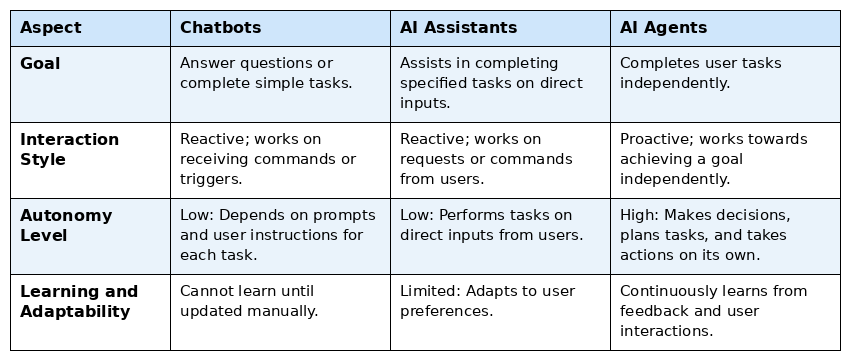


How does an AI Agent differ from Chatbots and AI Assistants? Now that the definition and workflow of AI Agents is clear, let’s understand how it differs from its predecessors (Chatbots and AI Assistants).
What are AI Agents?  
What features does an AI Agent have? From AI chatbots that simply responded to user commands, we now have AI Agents that offer the following features: Autonomy: An AI Agent shows an autonomous nature, performing tasks on its own with minimal human supervision. It works towards a goal and manages the entire task planning, execution, and refining independently.

Reasoning and Planning:

After receiving an objective, AI Agents break it down into smaller tasks and plan how to achieve the task. They use reasoning techniques to analyze the available information and find the best approach to achieve the goal. 

Decision Making: 

AI Agents have the ability to make decisions, they decide how to manage a complex task, find the best possibilities, and what actions to take. 

Adapting & Learning

Another promising feature of AI Agents is their ability to learn and adapt. They revise plans as per new information and recognize patterns over time to make better decisions. AI Agents also learn from user interactions and improve their performance based on human feedback. 

Tool Use: 

AI Agents can achieve goals by using tools and APIs that connect them to external knowledge resources and real-time data.

Proactive: 

An AI Agent is proactive; that is, it does not wait for commands and acts towards achieving a goal once given an initiative. 

AI Agent Real Industry Use Cases

Learn how AI Agents are implemented in real industry workflows with these use cases. 

HealthCare

Patient Service AI Agent: An AI Agent that answers patient questions, analyzes patient information including symptoms and health issues, schedules an appointment with the required doctor, communicates basic information about bills and insurance, and manages follow-ups. 

HR

Job Recruiter Agent: Companies use AI Agents that handle the recruitment process. They analyze hiring requirements, post openings on the company page and job platforms, collect resumes, analyze resumes against the requirements, score candidates according to the set criteria, and schedule interviews with the top candidate. 

Customer Experience

Customer Support Agent: Interact with customers to provide instant resolution and 24x7 support. Understand their issues, retrieve their information from databases, analyze the problem, and plan the appropriate solution.


Suppose a customer asks for a refund because an order has been delayed two times in a row. The AI Agent will check the customer ID and gather information such as the order details and tracking number, and analyze the problem. It will access the refund policy and decide whether the customer is eligible for a refund. Respond to the customer and inform them about the solution. 

Marketing 

Content Creation and Strategy: An AI Agent that not just generates content for different platforms but manages the content cycle. The agent researches and analyzes the market to create a content strategy. Creates video scripts, images for posts, and a content calendar. Also, posts the content on required platforms, analyzes performance metrics, and revises strategy accordingly. 

What Benefits Does Deploying an AI Agent Offer?

In line with current agentic AI trends, companies across industries are rapidly adopting AI agents to stay competitive. The reason most companies plan to deploy AI agents is the promising benefits these AI systems offer, such as:


  • Improved Efficiency

Implementing AI Agents into the workflow helps automate repetitive and time-consuming tasks. This helps human workers focus on strategic work and improves efficiency. 


  • Better Productivity

An AI agent performs well-defined and repetitive tasks 24x7, accelerating workflows and improving productivity. 


  • Cost Saving

Human errors and operational inefficiencies can be avoided with AI Agents. This helps companies save costs. 


  • Enhanced Decision Making

AI Agents can analyze large amounts of data, work on complex problems, and recognize patterns to help make better decisions. 


  • Scalability 

Companies can scale with AI Agents as they can manage complex, multi-step tasks, handle increased workload, and maintain consistent performance. 


As more companies adopt this technology, demand for agentic AI jobs such as AI agent developers, prompt engineers, and AI workflow architects is also rising fast across industries.

Limitations of an AI Agent

Along with benefits, implementation of AI Agents also creates challenges such as the following: 


  • Data leakage issues can be caused as AI Agents have access to databases and other resources.

  • AI Agents struggle with executing tasks that require deep human empathy or emotional intelligence. 

  • Since AI agents work autonomously, it is hard to determine who takes accountability for their mistakes. 

  • Ethical challenges can arise due to data bias and hallucinations. 

  • Integrating complex AI Agents into the workflow can be challenging and require domain expertise. 

Conclusion 

Over the last few years, AI has made tremendous progress and by 2026 the discussion is beginning to turn into action as businesses intend to put AI Agents into use on a large scale. These AI systems, which work independently to achieve their goals, have altered existing industry workflows, and companies intend to deploy them in order to improve efficiency and productivity. Since there is growing demand for skilled professionals, a number of agentic AI courses in India are now assisting learners in gaining hands-on experience in the construction and deployment of AI agents. If you too would like to build AI agents or want to find out more about them, you should look into the IIM SKILLS Agentic AI Course.

Professional Courses from IIM SKILLS


FAQs


Is ChatGPT an agent or LLM?

ChatGPT is not an LLM because it has agent-like features such as the ability to process natural language, memory for storing information and remembering past interactions, and access to tools. So, it can be said to be an AI agent. 


What 5 types of AI agents are there?

The 5 types of AI agents are: 


Simple Reflex Agents: They work only on the direct input based on predefined rules and conditions. 


Model-based Reflex Agents: They maintain an internal model and analyze the current input and past interactions to perform the task. 


Goal-Based Agents: They perceive the information, use planning, and take actions to achieve the defined goal. 


Utility-based Agents: To achieve the goal, they determine the utility value of each possibility and select the option with the highest utility. 


Learning Agents: They continuously learn from the collected information and feedback to improve their performance. They update their knowledge bases for better decision-making in the future. 


How much do AI agents cost?

The cost of AI agents depends on several factors such as the agent type (single or multi-agent), prebuilt or custom-made, and the complexity. A simple agent can cost Rs. 1,50,000 to Rs. 4,00,000, a medium-complexity AI agent can cost Rs. 4,00,000 to Rs. 12,00,000, and an enterprise AI agent can cost up to Rs. 40,00,000. 


What are the top 5 AI agents?

The top 5 AI agents are AgentForce by Salesforce, Devin AI, Claude Code, Nexos.AI, and Zapier Agents. 

Vanthana Baburao

Vanthana Baburao

Currently serving as Vice President of the Data Analytics Department at IIM SKILLS......

phone
Call
WhatsApp
We are here to help you.
phone
Call
WhatsApp
We are here to help you.