What are the Agentic AI Trends 2026?
The recently published industry reports and studies on AI point towards the following Agentic AI Trends in 2026.
Trend 1: Shift from Experiment to Deployment
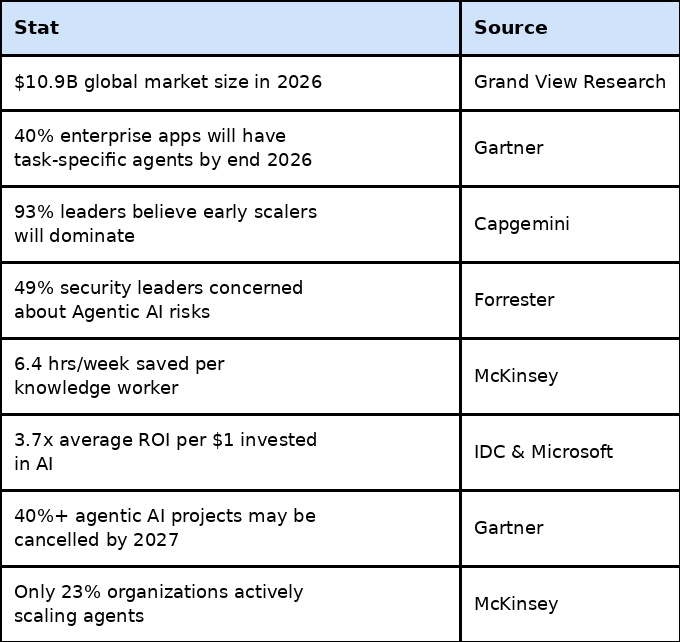
In 2025 the global agentic AI market was worth $7.6 billion and is expected to exceed $10.9 billion in 2026, representing a year-on-year increase of 43% (Grand View Research). It is no longer a matter of doubt for companies whether they need Agentic AI; the issue has now become one of how to implement it on a large scale. The 2026 Gartner CIO and Technology Executive Survey shows that 60% of organisations intend to deploy AI agents in the next two years. Furthermore, a Capgemini report states that within three years AI agents will carry out at least one business process each day in 58% of operations. The transition from experimental use to actual production is no longer a forecast it is taking place right now.
According to the 2026 Gartner CIO and Technology Executive Survey, 60% of organizations plan to deploy AI agents in the next two years. Another report from Capgemini states that within three years, in 58% of business operations, AI agents will handle at least one process or subprocess every day.
Trend 2: Focus on Building Multi-Agent Systems
Forrester and Gartner both see 2026 as the year when multi-agent systems achieve a breakthrough—when specialized agents work together under central coordination instead of operating alone. The change covers the entire range from carrying out simple task automation to managing end-to-end processes, and it is fundamental. According to the Anthropic 2026 State of AI Agents Report, companies are becoming more likely to deploy AI agents to take charge of whole workflows rather than having them provide collaborative support. The architecture is evolving from that of a single intelligent assistant to one that consists of an orchestrated network of agents, each specialized and each one breaking down goals into subtasks and assigning work according to context and capability.
According to McKinsey's State of AI 2026, organizations that redesign workflows around multi-agent systems rather than layering AI onto existing processes generate significantly higher returns.rather than for collaborative assistance. In 2026, Agentic AI is about AI systems that coordinate, make decisions, and act across workflows autonomously.
The shift is from isolated automation to an orchestrated system that handles the entire process by using different tools, agents, databases, and APIs. It breaks down the goal into smaller tasks and assigns the work depending on the issue and the level of knowledge required.
Trend 3: Implementing Task-Specific Agents
In 2025 fewer than 5 per cent of enterprise applications had task-specific AI agents and Gartner predicts that by the end of 2026 the figure will have risen to 40 per cent, representing an 8-fold increase within a single year. Rather than depending on general-purpose assistants, companies are now employing specialized AI models designed for specific functions such as resume screening, invoice processing, and compliance monitoring, etc. A task-specific agent carries out one particular task but does so with much greater accuracy, speed and cost-efficiency than a general-purpose model. According to IBM's 2025 CEO Study organizations which use domain-specific agents achieve a significantly higher return on investment when compared with those using general-purpose AI tools. Rather than using general-purpose assistants, organisations are now deploying specialized AI models for different tasks and processes. For instance, agent systems are used for resume screening, this involving the analysis of job applications, comparing the submitted resumes with the job descriptions and then scoring the candidates as a result.
Trend 4: Redesigning Processes
Companies need to restructure their processes to integrate AI agents into their workflows. They need to redesign the roles and approval processes to automate workflows. Agentic AI in 2026 is not just about moving faster to implement AI but about rebuilding workflows so that AI agents and humans can work together to scale and improve.
Redesigning workflows and business units is the key factor that helps companies go from exploring agentic AI to scaling it. This restructuring is required at all levels, including the need for employees to reskill or upskill. Leaders also need to ensure people are rewarded for their work.
Trend 5: Moving Towards Full Automation
Another Agentic AI Trend is the shift towards using artificial intelligence systems to achieve full autonomy. Meaning companies don’t plan to use AI as a supportive tool; rather, they want it to execute the entire tasks. Instead of using AI as a thought partner, organizations plan to implement it as a workforce.
The majority of organisations expect to use AI moderately; a report by Deloitte shows that 5% of organizations plan to fully integrate agents at the core of their business operations. However, even though companies aggressively work towards adopting AI agents, fully autonomous AI agents are not ready for most use cases.
Trend 6: Ensuring Ethical Safety and Data Readiness
Building autonomous systems that work without real-time human supervision can be risky. As per Forrester’s Security Survey 2026, Agentic AI is a concern for 49% of security decision-makers. It has become a necessity to govern AI systems to ensure safety and data security.
A survey from Deloitte shows that companies that succeed in integrating Agentic AI are taking a measured approach, starting with lower-risk use cases, developing governance capabilities, and scaling purposefully. Putting safety first is among the new Agentic AI Trends.
A report by Anthropic shows nearly half of the organizations (46%) face integration with existing systems as the main obstacle, while 42% report data access and quality issues. Thus, for effective AI deployment, companies need to have strong readiness in data integration and monitoring.
Trend 7: Hybrid Approach to Implement AI
Agentic AI Trends in 2026 include the rise of low-code and no-code platforms that help companies design and deploy AI agents, accelerating the adoption of Agentic AI. Companies save the time to build from scratch by using pre-built AI agents and customizing the templates according to their use cases.
A report from Anthropic shows that companies take different approaches to AI agents, with only 20% of companies developing their own Agents using APIs and developer toolkits. The rest either use pre-built agents (21%) or combine their off-the-shelf solutions with customer-built solutions (47%).
Trend 8: Emphasis on Context
To complete complex tasks and multi-step processes, AI agents need more context. A Report from Anthropic shows how a 1% increment in context length can increase the output quality and length by 0.38%. Companies that use disorganized data will find it difficult to unlock complex AI use cases.
If you’re looking to enroll in professional online courses then IIM SKILLS is here to offer the best courses with placement. Here are:
How Can Companies Adopt Agentic AI Trends?
The steps companies can take to benefit from these Agentic AI Trends in 2026 are:
- Follow a Strategic Approach: Define the roles and responsibilities of AI agents and human employees. Establish a structured framework and criteria for deploying AI agents.
- Reskill/Upskill Employees: Train employees in low-code tools, AI output quality control, and reasoned judgement. Enrolling in structured agentic AI courses can help employees build these skills faster.
- Establish Accountability: Decide who takes responsibility for decisions made by AI agents. Establish a balance between autonomy and human involvement.
- Performance Monitoring: Create a process to monitor if AI agents are achieving the desired business outcomes.
- Risk Management and Security Practices: Give every agent an identity, including login details and its owner who manages it, to ensure no agent is untraceable or unowned.
Conclusion
2026 is not the year Agentic AI arrives. It is the year excuses run out.
Market growing at 43% YoY. Enterprise adoption is growing. Multi-agent systems for manufacturing. The governance frameworks are being developed with or without your organization’s input.
The eight trends in this article have one thing in common: what you do now compounds. Just wrong direction . Delayed action compounds too .
Organizations redesigning workflows today will be the case studies others read about in 2027. The professionals upskilling now will be the ones leading those projects.
Professional Courses from IIM SKILLS
FAQs
What are the top Agentic AI trends in 2026?
In 2026 the leading Agentic AI trends are characterised by a shift from experimental stages to complete deployment, by the development of multi-agent systems, by the creation of task-specific agents, by restructuring workflows to incorporate AI, by progressing towards full automation, by securing ethical safety and data governance, by adopting hybrid low-code platforms, and by placing a greater emphasis on context in order to improve the quality of AI output.
How is agentic AI different from generative AI?
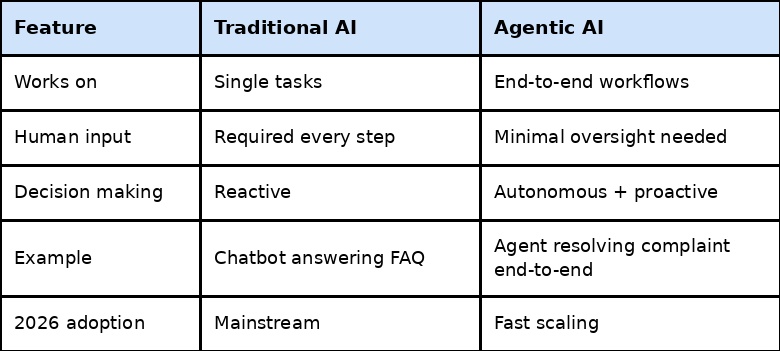
Generative AI produces content in the form of text, images, and code in response to prompts. Agentic AI does something even more advanced it takes action. Rather than merely responding to a prompt, agentic AI plans, makes decisions, and carries out multi-step tasks independently with only a small amount of human involvement.
Which are some of the best agentic AI frameworks in 2026?
The best Agentic AI frameworks are LangGraph, Crew AI, Google ADK, AutoGen, Llamalndex Workflows, and Intuz Agentic Framework.
Is 2026 expected to be the year of agentic AI?
Yes, 2026 is expected to be the year of Agentic AI, where companies shift from experimentation to deploying AI agents. Surveys show a high percentage of organizations plan to deploy and scale AI agents in the years to come.
Which industries will be most impacted by Agentic AI in 2026?
The industries most impacted by Agentic AI in 2026 include healthcare, finance, retail, manufacturing, and software development. These sectors are deploying autonomous AI agents to streamline operations, reduce costs, automate complex workflows, and make faster data-driven decisions at scale.
Is AI overhyped in 2026?
Although companies continuously work towards adopting AI, it can be considered a little overhyped in 2026. According to a Forbes article, “2026 is the Year of AI Evaluation, Not AI Hype”. There is not only excitement about Agentic AI, but also a growing need to understand its maturity levels, data quality issues, governance, and security concerns. Companies not only plan to deploy AI agents but also build safe and reliable systems.
What is the next stage in agentic AI?
The next level of Agentic AI is about building multi-agent and self-improving AI systems. It includes developing hybrid systems where AI agents work as team members, not as replacements for human workers. There will also be a focus on building governed autonomy so agents follow security practices and ethics.