





What is Agentic AI? Why Should You Learn in 2026?
August 1, 2026|
Vanthana Baburao|
Knowledge|
Ever since the existence of AI came into view, there have been new developments related to AI, and now the shift is towards Agentic AI - the systems that are automating workflows, making decisions, and completing complex tasks without having a human guiding them at every step. If you are someone who wishes to understand “What is Agentic AI?”, how it works, and learn its benefits and limitations, then you should give this a read.
What is Agentic AI?
The term “Agentic” refers to the ability to act independently, mimic human decision-making, and achieve specific goals. Agentic AI is an advanced AI system that can achieve multi-step goals, plan tasks, make decisions, solve problems, and execute complex tasks autonomously without requiring human guidance at every step.
If you're someone who is interested in Agentic AI, then IIM SKILLS Agentic AI Course is best option for you.

How Exactly Does Agentic AI Work?
Based on the definition, it is clear that Agentic AI works autonomously, but exactly how it works when given an objective is what we cover in this section.
Step 1: Perception
The first step an Agentic AI system does is to collect information from the available sources, including user interactions, memory, sensors, or APIs. This provides the information required to understand the context before performing the task.
Step 2: Reason
After collecting the information, the next step for the AI agent is to understand what to make of that information. At this stage, they analyze data, understand user conversation, detect patterns, and develop possible solutions.
Suppose you ask an AI agent to plan a 2-day vacation to Goa under Rs. 20,000. So at this stage, AI agents will start reasoning whether a train or flight ticket will fit your budget, what kind of hotel (luxury or modest) goes with the budget, and other factors. It will start analyzing and evaluating the options.
Step 3: Plan
The next step after collecting and analyzing information is to plan the task. At this stage, AI agents set a goal and divide it into smaller tasks to achieve the desired results.
Continuing the example above, at this stage, the AI agent will start planning step-by-step tasks:
First, it needs to decide on transportation to Goa.
Next, it needs to select a hotel based on your preferences. Compare the hotel options and choose a budget-friendly option.
Find activities.
Calculate the total cost and verify that it matches the budget.
Step 3: Execution
Once the goal is set and steps are determined, the next step is to execute the tasks by accessing external tools such as APIs and AI agents. This step is all about taking actions and achieving the goals.
At this stage, Agentic AI systems start by booking flights and train tickets, searching and comparing Hotels to find the most suitable option, building a schedule of activities, and presenting the full travel plan.
At this stage, the AI agent can also book the hotel and tickets once you confirm.
Step 4: Revise and Improve
This step is about learning and improving. After executing the tasks, Agentic AI studies the outcomes, repeats the tasks, and reflects on the human feedback to improve its performance and effectiveness.
Looking to upgrade your skills in 2026? Then check out the Analytical Courses offered by IIM SKILLS.
What Distinguishes Generative AI from Agentic AI?
Generative and Agentic AI are both branches of Artificial Intelligence, due to which both the terms can feel confusing. Here is a table that showcases the difference between the two.
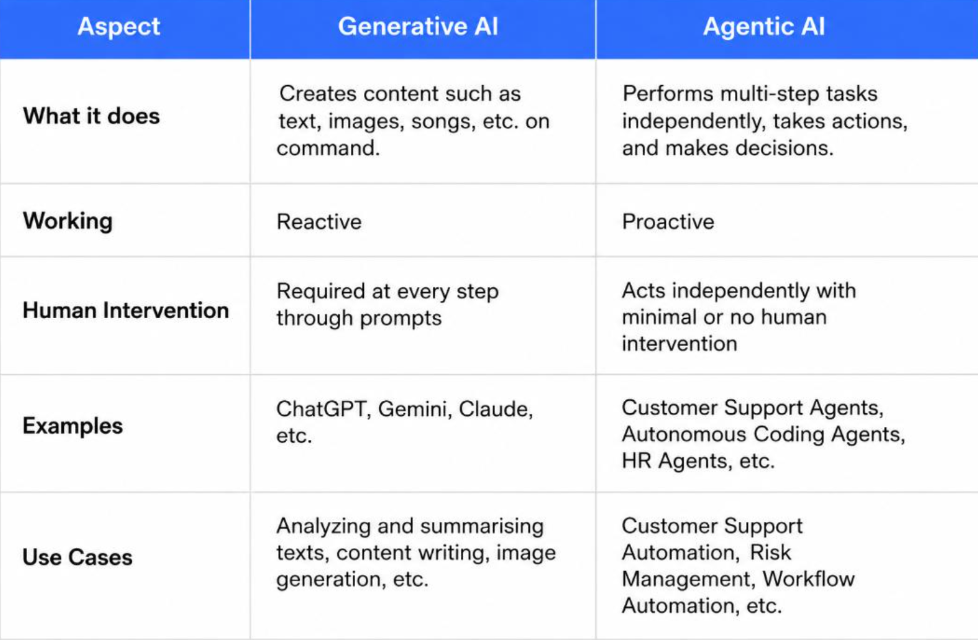
To understand this difference with an example: With a simple prompt to Generative AI, one can get content for marketing purposes. However, with Agentic AI, you not only get content but also have it manage posting, performance tracking and analysis, and suggest improvements to marketing strategies based on observations, all with minimal or no human supervision.
Unlike Generative AI, which requires prompts at every step to work, Agentic AI only needs an objective, and it decides how to achieve it on its own, including collecting information, understanding context, planning tasks, taking actions, making decisions, adapting to changes, and completing multi-step tasks.
Examples of Agentic AI
By the end of 2026, 40% of enterprise applications are expected to integrate task-specific agents. Here are some examples of how AI Agents are used in different areas of work.
Create AI agents that plan the software development process, write code, debug, test, and deploy the application with minimal human intervention.
Autonomous Hiring Agent
AI agents create job posts, publish them on job boards, screen resumes against job requirements, select the most suitable candidates, conduct the initial screening, and schedule interviews with respective departments.
Onboarding New Employees
Agentic AI handles the entire onboarding process, from sending the welcome letter to scheduling the joining interview, providing system access and emails, setting up the candidate profile, and completing the documentation process.
Customer Support Agent:
Customer Support Agents that manage tickets autonomously. They receive the customer query, gather order history, analyze the problem, plan the solution, make decisions, respond to the customer about the resolution, and escalate the issue to humans wherever required.
Autonomous Software Development
What Benefits Does Implementing Agentic AI Offer?
The need to implement Agentic AI in workflows comes from the strong benefits the technology promises, such as:
Works Autonomously
The biggest benefit of Agentic AI is that it can work independently with no human supervision required at every step. Agentic AI mimics human decision-making so it can reason, plan, and take actions autonomously.
Efficient
Repetitive and complex tasks that take humans hours to complete can be handled autonomously by AI agents, so humans can focus on more strategic and creative tasks that require human expertise.
Improves Productivity
Companies using AI agents have reported productivity gains, claiming Agentic AI improves efficiency and accelerates workflows. With Agentic working 24x7 independently, teams can achieve more goals in less time.
Cost Effective
With AI agents integrated into the workflow, companies can avoid human errors, detect fraud, assess risks, and reduce costs.
Adapt & Improve
Agentic AI reflects on its output, adapts to changing conditions, and improves its performance based on feedback. It can learn from its mistakes and enhance its effectiveness.
If you’re looking to upgrade your skills in 2026, then here are some IIM SKILLS Master Courses you should go for:
What is the limitations of Agentic AI
When learning “What is Agentic AI”, it is important to understand its demerits as well to avoid using/building AI systems that are unsafe and ungoverned.
Similar to Generative AI, Agentic AI also has security issues and privacy concerns. Without proper permission-based systems in place, if AI agents are given complete control over the database, it may cause serious data breaches and security concerns.
When AI agents are working autonomously, it is important to decide who bears the accountability for the errors. It is essential to test the AI systems before deployment and build a strong compliance framework.
When AI agents are performing a multi-step goal, a single wrong assumption or data in earlier steps can cause the entire process to fail.
It is important to understand that before implementing Agentic AI, professionals need to build the required AI expertise, define clear task boundaries, and set up guardrails to develop safe autonomous systems.
Conclusion
Capable of making decisions and handling multi-step workflows autonomously, Agentic AI is the future now. From healthcare to finance, education, retail, e-commerce, or manufacturing, AI agents are increasingly being adopted at a larger scale. If you also wish to learn more about Agentic AI and how to build AI agents, then do check out the IIM SKILLS Agentic AI Course.
FAQs
What separates Agentic AI from Generative AI?
Agentic AI and Generative AI differ in their approach to work. On one hand, Generative AI follows a reactive approach and creates content such as text, images, and videos on receiving prompts. On the other hand, Agentic AI handles the entire process and completes multi-step tasks, performing reasoning, planning, executing, and improving.
Can we ensure agentic AI is transparent?
Yes, we can ensure Agentic AI is transparent by documenting and monitoring its decision-making process at every step and using methodologies such as Explainable AI (XAI). However, it is important to know that achieving complete transparency can be difficult.
How to implement AI agents into an existing software?
To integrate AI into your existing software, the first step is to identify the repetitive processes in your workflows. Next, choose a suitable integration framework and AI models. You also need to set up data mappings, test its functionality, and deploy.
How to calculate the Agentic AI ROI?
To measure the Agentic AI ROI, a simple formula is used, which is:
(Net Profit - Total Cost) / Total cost x 100
Companies need to determine the cost of implementing and running AI agents against metrics such as productivity gains, cost reductions, efficiency, and revenue growth.
What happens when an agent gets stuck?
When an AI agent gets stuck, it enters a repetitive loop. To fix this, you might need to stop the Agent, clear its memory, or set up a new spin Agent, and put in a strict maximum actions threshold.
How are businesses using agentic AI?
Businesses are using agentic AI and AI agents for workflow automation and performing complex tasks. Companies implement task-specific AI agents; some of the examples are: Customer Support, where AI agents handle the queries and escalate issues to humans where required. Sales and Marketing - AI agents find quality leads and send personalized messages.
What is the science behind agentic AI?
The science behind Agentic AI includes Large Language Models (LLMs), planning and decision-making models, memory, and tool use. It uses LLMs to understand instructions and reasons and plans tasks to achieve multi-step objectives, and mimics human decision-making to solve problems.
What does the future hold for agentic AI and AI agents?
The future of Agentic AI and AI agents is promising, with a 72% increase observed in the adoption of AI. Organizations report AI agents are already being adopted in their workflows, and 66% of them have seen measurable productivity improvements. However, implementing agentic AI has its own challenges and can be unsafe and unreliable if not handled properly.
Is it possible for agentic AI to work with existing enterprise systems?
Yes, Agentic AI can work with your existing enterprise systems and improve overall efficiency.
Which companies are developing agentic AI technologies?
Some of the major companies developing Agentic AI technologies are Google DeepMind, OpenAI, Amazon, Anthropic, Microsoft, Straive, etc.
What separates traditional AI models from agentic AI systems?
Traditional AI models work on commands, requiring human guidance at every step. They stop after answering or completing one specific task. Agentic AI systems, on the other hand, work independently, and you only need to provide them with a task; the rest of the process- planning, executing, problem solving, and completing is their work.
Best platforms offering agentic AI tools for businesses?
Salesforce, Microsoft Copilot Studio, Crew AI, and Zapier Central are some of the best platforms providing Agentic AI tools.
How can agentic AI improve customer service in Indian companies?
Agentic AI systems improve customer service by resolving customer queries instantly. AI agents not only answer simple customer questions; they understand customer problems, analyze the information, retrieve historical data from databases, plan the solution, and execute it autonomously. They work as 24x7 customer support specialists.
Explain the architecture of a typical AI agent framework?
The architecture of an AI agent framework consists of a Large Language Model (LLM) that acts as the brain of the AI system, a memory that stores past experiences, user interactions, etc, and external tools and APIs. The system collects information and sets the objective, retrieves information, reasons and plans the task, breaks it into smaller actions, executes the task, accesses external tools, and adapts to changing conditions.

Vanthana Baburao
Currently serving as Vice President of the Data Analytics Department at IIM SKILLS......