With the growing Agentic AI job opportunities, interest in these roles is also increasing. However, from the thousands of applications that companies receive for a single role, only a few are selected for the interview. Additionally, as companies focus more on testing candidates' real-world knowledge of designing and building Agentic AI systems, thorough interview preparation is more important than ever. If you are preparing for interviews and don’t want to lose the opportunity because of incomplete preparation, go through this list of Agentic AI interview questions and sample answers. This will help you navigate through the interviews confidently.
Agentic AI Interview Questions and Answers 2026: Beginner to Advanced Guide
August 26, 2026|
Vanthana Baburao|
Agentic AI|
Beginner Level Agentic AI Interview Questions: Testing The Basics
Define Agentic AI and explain how it differs from traditional AI?
Agentic AI is an advanced AI system that plans, reasons, uses tools, and divides complex tasks into smaller goals to achieve the specified objective with minimal or no human supervision.
Differences:
Traditional AI works on receiving user instructions and predefined rules. However, Agentic AI manages complex tasks autonomously, including breaking the goal into smaller tasks, reasoning through them, and taking action on its own.
Agentic AI can adapt to its environment and improve based on feedback; however, traditional AI cannot adapt on its own and requires human intervention
What separates an AI Agent from Agentic AI?
Agentic AI vs AI Agents What Is the Difference? When comparing Agentic AI vs AI agents, the key difference is that an AI agent is a component of the larger Agentic AI system. An AI agent performs user-defined tasks under predefined conditions, whereas Agentic AI manages the entire process from understanding context to planning the task, taking actions, adapting to changes, and completing tasks. This Agentic AI vs AI agents distinction is one of the most commonly asked questions in interviews. I agents work independently, whereas an Agentic AI system coordinates multiple agents and components.
What are the fundamental components of an AI agent?
The core components of an AI agent are a reasoning engine, memory, planning, tools, and instructions.What is a reasoning loop?
A reasoning loop is an iterative process that an AI agent uses to achieve a complex goal. During this, the AI agent plans a step, takes actions, and studies its results to interpret the next step. It keeps repeating the same steps over and over until it achieves the desired outcome.What are real-industry applications of Agentic AI?
Some of the real-world applications of Agentic AI are autonomous customer support systems that handle customer queries on their own. The systems start with understanding the customer problem, extracting information such as the order ID, tracking details, etc, checking the policies and other training material to plan the solution, and making decisions.Other examples are autonomous travel planners, multi-agent research assistants, and autonomous HR onboarding systems.
What LLMs have you used, and which are the best ones for agents?
Candidates need to mention the latest LLMs they have worked with for this question. For example, if they have worked with GPT-4.0 or Llama, candidates will have to explain them in detail and also reveal the purpose behind using them.What is RAG?
RAG (Retrieval-Augmented Generation) is a method that an AI model uses to connect with external information sources, collect relevant and updated information, and produce more accurate responses. This way, the model does not have to depend on the training data alone and can provide more domain-specific information.
Intermediate Level Agentic AI Interview Questions
Why is memory important for AI agent performance?
An agent's memory provides it the ability to store information, remember past interactions, and understand patterns to make better decisions. The memory helps the agent improve performance by understanding context, adapting to changes, learning from interactions and feedback, and tracking progress.Which type of memory do AI agents use?
AI Agents use two types of memory: short-term and long-term.
Short-Term Memory: Stores information about the ongoing conversation and maintains context during the entire session.
Long-Term Memory: Stores and recalls information from different conversations and past interactions. It is divided into three types: Episodic Memory, Semantic Memory, and Procedural Memory.
What is task decomposition?
Task decomposition is the process of dividing a complex or larger goal into smaller tasks that can be performed independently.
For example: To complete the goal “Plan a Goa Trip under Rs. 20,000”, the agent breaks the task into smaller steps such as:
Step 1: Find the mode of transportation and book the tickets.
Step 2: Compare Hotels and select the one that matches the preferences.
Step 3: Find famous activities.
Step 4: Calculate the total cost and compare it against the given budget.
What is the ReAct framework?
What are tool use and function calling, and how do they differ from each other?
Tool use is the ability of an AI Agent to connect with external tools, APIs, and databases to complete complex tasks. This helps AI agents access external resources and real-time information.
Function Calling is used when AI agents need to call external functions for specific tasks that require more than pretraining data.
If you’re looking to enroll in professional online courses then IIM SKILLS is here to offer the best courses with placement. Here are:
How do you track and evaluate the performance of agents in production?
To track and evaluate the performance of an Agent, the following steps are taken:
Check whether the AI agent is providing accurate information based on its training data and databases.
If the Agent fails to complete the task, determine the reason for task failure.
Check whether the AI agent provides consistent performance for the same inputs.
Observe the efficiency: how many tokens the AI agent uses, how quickly it resolves the issues, and whether it provided the right answer.
Determine what success looks like: latency, success rate, tokens used, accuracy, and efficiency.
What is Chain-of-thought (CoT) reasoning and how important is it in Agentic AI?
Chain-of-thought reasoning is a technique that AI agents use to break a complex problem into intermediate steps to provide accurate results. It is important because:
Rather than guessing the output, the AI Agent reasons through the tasks, plans the steps, and completes them to improve accuracy.
Completes multi-step tasks that require reasoning and planning.
Easier to debug and interpret results.
When should you implement multiple agents in place of one agent with multiple tools?
Multiple agents should be implemented when the tasks are separable and properly specified. Other reasons include:
Parallel Work: The tasks can be performed independently at the same time.
Security Reasons: Some agents are required to be restricted from accessing tools or databases.
Long Task Chain: A single agent cannot remember the earliest step when it executes a long task chain. So a multiple-agent system would be preferable.
What would you do to debug a multi-agent system that produces wrong output?
Candidates need to describe from their experience how they debugged a system producing wrong output. If they have not done it practically, then explain it through theory. A sample answer would be:
Step 1: Trace the workflow, including the tool use, prompts, and handoffs between agents.
Step 2: Start from the wrong output and trace the workflow backward to see which agents or part of the process shows failure. Isolate that agent or step.
Step 3: Check what recurring failure pattern your failure matches to find the fix.
Step 4: Find the root cause of the problem and apply the solution.
What are the security concerns regarding deploying autonomous agents?
The security risks related to AI Agent deployment are:
Prompt injection: Agents receive malicious inputs in the form of prompts, making them ignore the predefined rules and instructions and leak sensitive information.
Cascading Error: An error in the earlier steps cascades and affects the output of other agents.
Risks Sensitive Data: Due to tool misuse or agents exchanging data autonomously, sensitive information can be leaked.
Over-access: When an AI agent has excessive access to tools and other resources, more than it needs, it can cause security issues.
What is the human-in-the-loop approach and why is it needed?
Human-in-the-loop approach (HITL) refers to the involvement of humans in the AI system's lifecycle. The human supervises the AI workflows, including its operation, decision-making process, and learning, to ensure safety and accuracy.
HITL process is needed because it helps ensure:
The AI system produces accurate output and does not misuse information.
AI agents are not solely responsible for actions; HITL ensures proper accountability for actions.
HITL helps improve fairness in outputs by reducing data bias.
Involvement of humans in the workflow increases the trust of users in the system.
How do you prevent your agent from getting stuck in an infinite planning or execution loop?
To prevent my agents from getting stuck in an infinite planning or execution I follow these steps:
Set a maximum number of interactions or hop counts allowed.
Implement termination functions that help agents terminate the task before hitting the allowed hop counts.
Spot the agents that are showing repetitive behaviors, providing the same responses or output.

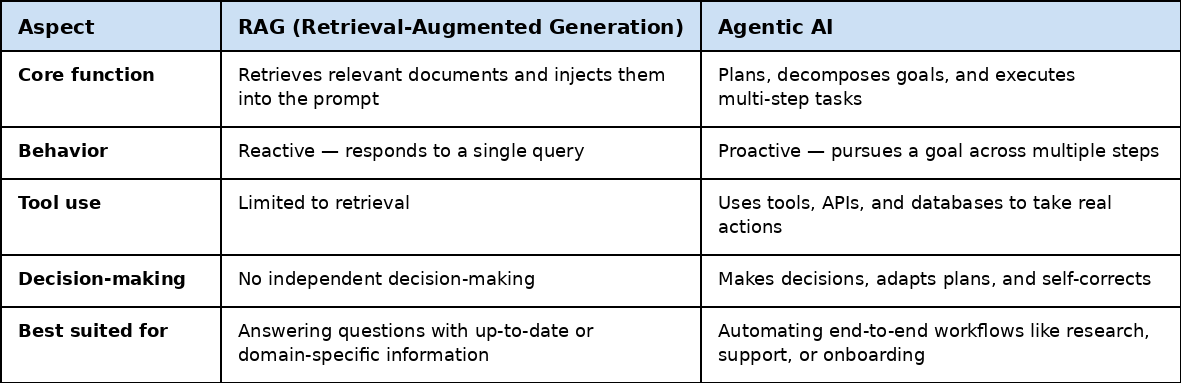
Agentic AI vs RAG: What's the Difference?
Many candidates confuse RAG with Agentic AI since both deal with external information. The key difference lies in autonomy and action.

Tips For Answering The Agentic AI Interview Questions
Some of the tips that candidates expecting to be interviewing for Agentic AI jobs can follow are:
Have Opinions: Do not repeat a textbook definition; interviewers want to assess your understanding. So be specific about why you use a particular framework, how you solve problems, and explain your working process.
Be Practical: Speak from your own experience; take interviewers through your working approach. Avoid only using theoretical definitions.
Stay Updated: Read current industry reports, newsletters, and insights to stay updated with the ongoing industry trends.
Practice with Mock Interviews: Along with practising Agentic AI Interview Questions, take mock interviews that strengthen your skills and confidence.
Show Willingness to Learn: If you don’t know the answer or don’t have the required experience for the specific question, be honest about it. Show the willingness to learn, but don’t make up incorrect answers.
Professional Courses from IIM SKILLS
Conclusion
Practising these Agentic AI Interview Questions provides a strong base for your interviews and improves your confidence. From beginner-level to advanced Agentic AI Interview questions, the article covers a variety of topics that enhance your knowledge and make you interview-ready. To further improve your interview skills, you can also take mock interviews that will strengthen your understanding and work on projects to demonstrate real-world knowledge.
If you are searching for the best Agentic AI courses in India, the IIM SKILLS Agentic AI Course provides expert support at every stage of your journey, from learning core concepts to preparing for interviews. Explore the course to know more about the benefits.
FAQs
Are Agentic AI roles more advanced than traditional AI roles?
Yes, Agentic AI roles are more advanced because they don’t just stop at training AI models that complete well-defined tasks. Agentic AI roles require candidates to build multi-agent systems that work autonomously. Candidates need to ensure security and design safe and reliable systems that can manage entire workflows, plan tasks, reason, use tools, and make decisions, all on their own.
How to prepare for Agentic AI Interviews?
Start with strengthening your basics; learn how AI agents work, practice the frameworks, and address security concerns. Practice the Agentic AI interview questions, take mock interviews, and identify your areas of weakness. Read newsletters and reports to stay updated.
Is Agentic AI the future?
Yes, Agentic AI is the future of artificial intelligence, shifting from completing tasks to managing entire workflows. Most companies plan to deploy AI agents in the coming years, and the demand for Agentic AI is increasing.
What are the challenges related to Agentic AI?
Although Agentic AI promises several benefits, there are still challenges such as agents getting stuck in infinite loops and cascading errors, sensitive data leakage through tool misuse, lack of accountability, and over-permissioning.

What skills are required to crack an Agentic AI interview?
In order to pass an Agentic AI interview, candidates must have a solid grasp of Python programming, API integrations, and LLM frameworks such as LangChain or CrewAI. Together with their technical abilities, they should also be at ease when explaining reasoning loops, memory systems, tool orchestration, and multi-agent architectures. Awareness of vector databases, prompt engineering, and basic system design is likewise required for intermediate and advanced positions.
What is the average salary for Agentic AI roles in India?
In India agentic AI positions are some of the highest paid AI occupations because they require a specialized range of skills. Entry-level roles generally begin at a higher salary than standard AI or software positions, and experienced individuals who work on multi-agent systems and in production deployments are able to secure much higher salaries. The amount earned depends on the size of the company, where the person is located, and on their actual experience in building and deploying real-world agentic systems.

Vanthana Baburao
Currently serving as Vice President of the Data Analytics Department at IIM SKILLS......