




Agentic AI vs AI Agents: Full Comparison Guide 2026
August 21, 2026|
Vanthana Baburao|
|
A report from Capgemini shows 61% of organizations are exploring Agentic AI deployment. And even though the adoption is accelerating, there remains confusion about “Agentic AI” and “AI Agents”. Both terms are often used interchangeably and are closely related, which creates confusion. Although Agentic AI and AI agents share some fundamental characteristics, they differ in aspects such as scope of work, level of autonomy, and complexity. To understand their differences, read this article that explains the topic “Agentic AI vs. AI agents” in detail.
What are AI Agents?
AI Agents are systems that execute specified tasks under user-defined rules and demonstrate a certain level of autonomy in decision-making and adaptability. They perform repetitive tasks under well-defined conditions and can interact with external tools and APIs to complete the task.
AI agents can either work as a single intelligent agent or as part of a multi-agent system. They interact with the environment and use tools to complete the tasks. They can reason about what to do, plan tasks, use external tools, and execute actions to achieve the outcome defined by the human with minimal or no supervision.
How Does an AI Agent Work?
After receiving instructions from users, an AI agent begins performing the tasks by following the steps mentioned below.
- Understand the tasks and build a plan to execute the process.
- Gather the required information and reason through the specified task.
- Use tools to execute the determined steps.
- Complete the tasks and adapt through feedback.
What is Agentic AI?
Agentic AI is an advanced system that executes complex tasks autonomously through AI agents. If you want to explore what is Agentic AI in more depth, it essentially uses AI agents, memory, external tools, APIs, and data sets to complete multi-stage tasks that require decision-making, planning, collaborative reasoning, and reflection.
Agentic AI demonstrates goal-driven behaviour and mimics human decision-making, which is why it can handle end-to-end processes without or with minimal human supervision. It can perform multiple-step processes by coordinating agents and integrating LLMs with tools, memory, and APIs.
How Does an Agentic AI System Work?
An Agentic AI system follows a series of steps to achieve the objective, and commonly they are as follows:
It first gathers the required information from different sources.
Then, it analyzes the information to understand the context and develop solutions.
After this, it breaks the objective into smaller tasks and determines the best way to accomplish it.
It finally starts taking actions and interacting with other tools to complete the process; all this is done with minimal or no human supervision.
After executing the complete tasks, Agentic AI reflects on its results and improves its performance based on the feedback.
If you’re looking to enroll in professional online courses then IIM SKILLS is here to offer the best courses with placement. Here are:
How Agentic AI and AI Agents Differ From Each Other
A simple way to explain “Agentic AI vs. AI agents” is that AI agents are the components of an Agentic AI system, used to perform multiple-step processes. As stated in a Google Cloud article, “AI agents are similar to individual tools in a toolbox, and Agentic AI is the coordinated use of those tools to build an entire house.”
Understand Agentic AI vs. AI agents in this section, which distinguishes them by their features, autonomy level, core functions, ability to adapt, and other aspects.
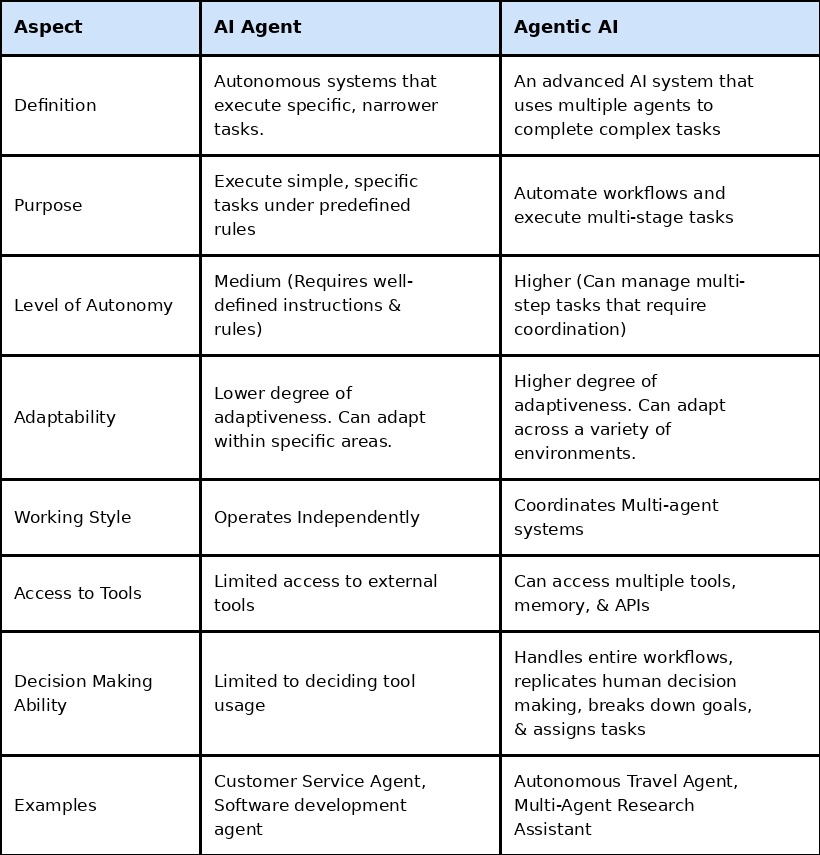
Agentic AI vs. AI Agents: A Detailed Comparison Analysis
Agentic AI and AI Agents both can demonstrate the same capabilities but at different levels. Let’s understand this difference in degree of capabilities and features in detail here.
Scope of Work
AI Agent: A single agent executes tasks under well-defined instructions and rules to achieve specific goals such as “initiating a refund”, “finding the cheapest flight”, etc.
Agentic AI: Can work in open-ended environments and complete complex tasks autonomously, including planning, reasoning, coordinating, and execution.
Level of Autonomy
AI Agent: An AI agent works with limited autonomy, requiring human instructions and prompts to start tasks. It can use tools autonomously and achieve human-defined goals.
Agentic AI: A higher degree of autonomy with control over how to approach the goal, assign tasks among agents, improve the plan based on context, and make decisions.
Coordination
AI Agent: They work independently and operate as an isolated unit. A single agent can connect with tools but not with other AI agents, unless it is working in a multi-agent system.
Agentic AI: It can coordinate multiple agents, tools, memory, databases, and APIs, following a decentralized coordination mechanism.
Adapting and Learning
AI Agent: Does not learn continuously and depends on instructions from humans. Can adapt in specific domains and at certain levels.
Agentic AI: Can learn from its outcomes and feedback. Adapts across different environments and improves its plans based on context and actions.
Complexity
AI Agent: Can handle specific tasks that require tools integration, basic reasoning, and execution. Cannot coordinate workflows autonomously.
Agentic AI: Can handle complex tasks that require multi-agent coordination. Demonstrates the ability to manage highly complex workflows autonomously.
Real Examples to Understand Agentic AI vs. AI Agents
Let’s learn more about Agentic AI vs. AI agents with real examples. If an AI Agent or Agentic AI is to be implemented in a customer support service, what tasks will it perform?
AI Agent: If a customer has a well-defined problem such as “where is my order”, “how can I return/exchange this item,” “I did not get the item”, etc., then an AI agent can be used. It will retrieve customer information and order details, and generate a response depending on the problem.
Agentic AI: The customer support workflow can be managed autonomously with an Agentic AI system that handles the entire process from understanding the customer problems, extracting their information, planning the solutions, assigning the tasks to specialized agents, making decisions such as whether the order qualifies for a refund, and escalating the issue to human customer support wherever required.
The main distinguishing feature is that an AI agent can answer queries and perform specific tasks, whereas an Agentic AI system works as the orchestrator handling the entire workflow. It can solve a complex user query from start to finish, completing multiple complex steps using specialized agents, tools, APIs, and practices. 
Agentic AI vs AI Agents: Industry Use Cases
Healthcare
Agentic AI vs AI Agents: Industry Use Cases
AI Agent: A chatbot that asks patients about their symptoms, analyzes the information, and tells them whether to see a doctor.
Agentic AI: A system that works on the broader goal such as “help this patient get the right treatment”. The systems start by checking symptoms, looking at the patient's medical history, reasoning through the situation, booking an appointment with the right doctor, and following up after the visit, all on its own, from start to finish.
Finance
AI Agent: An AI system that analyzes transactions and flags the ones that look suspicious, like a large payment from a new device.
Agentic AI: A system that handles the loan application process from verifying documents to looking at credit history, deciding whether to approve it, and even sending the applicant a message without a human doing each step.
HR and Recruitment
AI Agent: A tool that screens resumes based on set criteria like skills or experience.
Agentic AI: A system that handles the entire recruitment process, from screening resumes to scoring candidates, shortlisting the top ones, scheduling interviews with the respective department, and sending follow-up messages.
Professional Courses from IIM SKILLS
Conclusion
Learning about Agentic AI vs. AI agents helps us understand that both terms originate from generative AI and that, in one sense, they overlap significantly. One is an isolated system working on specified tasks while the other is a broader, goal-oriented system handling entire workflows autonomously. Both AI agents and Agentic AI systems work autonomously but on different levels, which makes the terms closely related and sometimes confusing.
If you want to learn more about Agentic AI and AI agents in detail, then explore some of the best Agentic AI courses in India, including the IIM SKILLS Agentic AI Course.
FAQs
What types of AI agents exist?
AI agents are categorized based on their decision-making capabilities, level of autonomy, and complexity. The five main types are simple reflex agents, model-based reflex agents, goal-based agents, utility-based agents, and learning agents.
What is an example of Agentic AI?
An example of Agentic AI is an autonomous HR onboarding system that handles new employees' onboarding, including sending welcome emails, providing IDs and required access, scheduling the joining interview, setting up the system, and completing mandatory training.
Are AI agents a part of Agentic AI?
Yes, an Agentic AI system consists of multiple agents, which it uses according to the task. However, it is important to note that an AI agent doesn’t necessarily have to be part of an Agentic AI system; it can work independently as a single agent.
What is the difference between agentic AI and multi-agent AI?
Agentic AI is an advanced AI system that completes end-to-end processes by using agents and other components to reason, plan, and execute tasks. Whereas multi-agent AI is a structured architecture used in an agentic AI system to coordinate multiple specialized agents, where they collaborate, communicate, and perform tasks.
Does Agentic AI involve the use of AI agents?
Yes, Agentic AI involves using different AI agents to complete complex tasks. However, an Agentic AI system doesn’t only use AI agents; it also uses external tools, APIs, databases, and memory.
Agentic AI is an advanced AI system that completes end-to-end processes by using agents and other components to reason, plan, and execute tasks. Whereas multi-agent AI is a structured architecture used in an agentic AI system to coordinate multiple specialized agents, where they collaborate, communicate, and perform tasks.

Vanthana Baburao
Currently serving as Vice President of the Data Analytics Department at IIM SKILLS......