Before this question comes in mind "How many papers in ACCA", check you're eligible to register on the standard route. ACCA's minimum entry requirement is typically two A-Levels and three GCSEs (or their recognised equivalents — in India, this generally maps to 10+2 with a minimum aggregate, though exact equivalency is assessed at registration), including English and Mathematics.
If you don't meet this yet,most commonly school-leavers who haven't completed the required subjects, ACCA offers the Foundations in Accountancy (FIA) route as an entry point. FIA lets you build up foundational papers first and progress into the main 13-paper ACCA Qualification once you're ready, rather than being blocked from starting altogether. If this applies to you, it's worth checking FIA eligibility before assuming the standard 13-paper count is your starting point.
The Full ACCA Papers List by Level
ACCA structures its 13 papers to build knowledge progressively — each level assumes you've internalised the one before it.
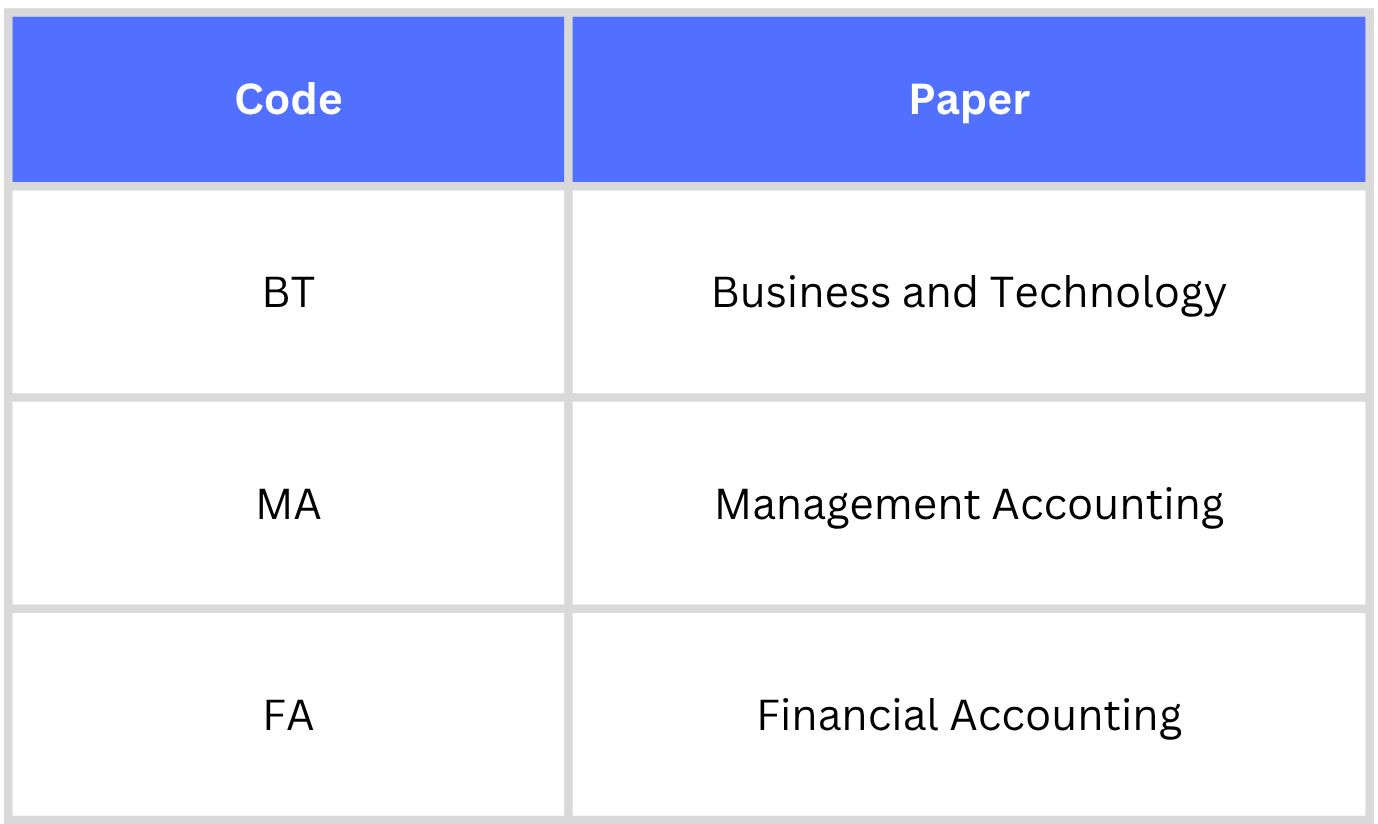
1. Applied Knowledge (3 papers)
The entry point. These introduce core accounting and business concepts and typically have the highest pass rates of any level (roughly 65–88%, per recent ACCA session data).
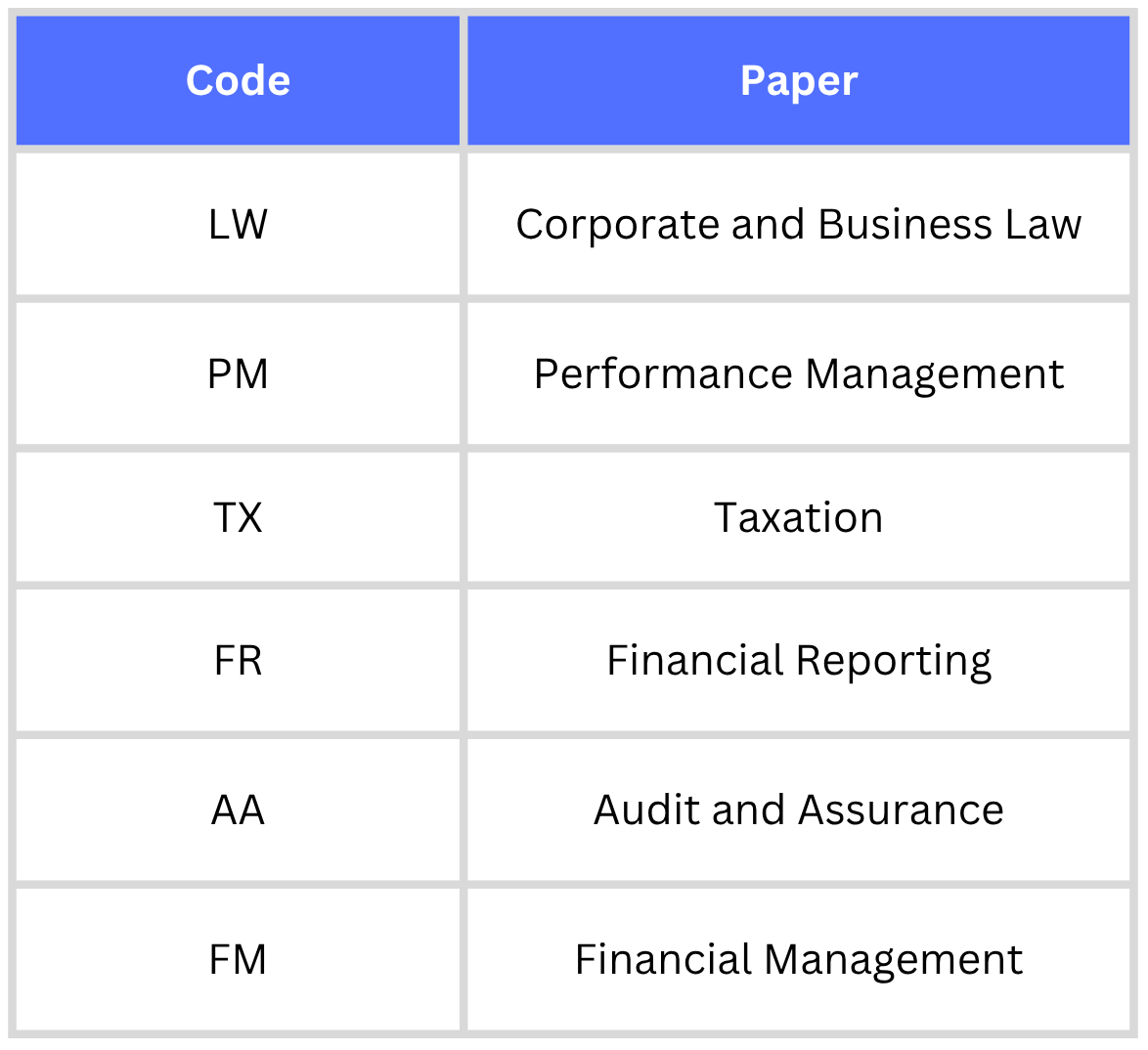
2. Applied Skills (6 papers)
This is where things get technical. Pass rates drop to roughly 40–55% because these papers demand applied, scenario-based thinking rather than recall.
3. Strategic Professional (4 papers)
The final stage, two compulsory papers plus two chosen from a set of four options.
Compulsory:
Choose any 2 of these 4:
Advanced Financial Management (AFM)
Advanced Performance Management (APM)
Advanced Taxation (ATX)
Advanced Audit and Assurance (AAA)
If you’re looking for structured guidance to navigate all three ACCA levels, you can also explore the ACCA Course by IIM SKILLS to support your preparation from the basics to the Strategic Professional level.
ACCA Recent Session Pass Rates
(Applied Knowledge vs Applied Skills)
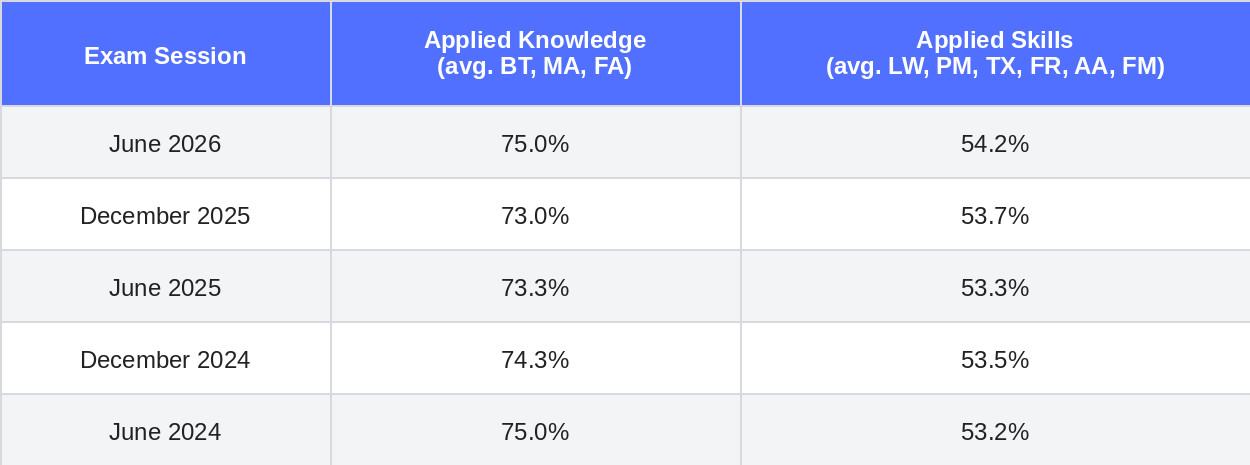 Source: ACCA Global official pass-rate data (accaglobal.com - Applied Knowledge and Applied Skills exam pass rates page).
Exemptions: What You Actually Qualify For
The 13-paper count is the maximum. Most Indian students don't sit all 13 exemptions based on prior education reduce the workload significantly.
Important: Exemptions only apply to the 9 papers at Applied Knowledge and Applied Skills level. No qualification, not even a CA Final, exempts you from any Strategic Professional paper. Everyone clears at least those 4 papers.
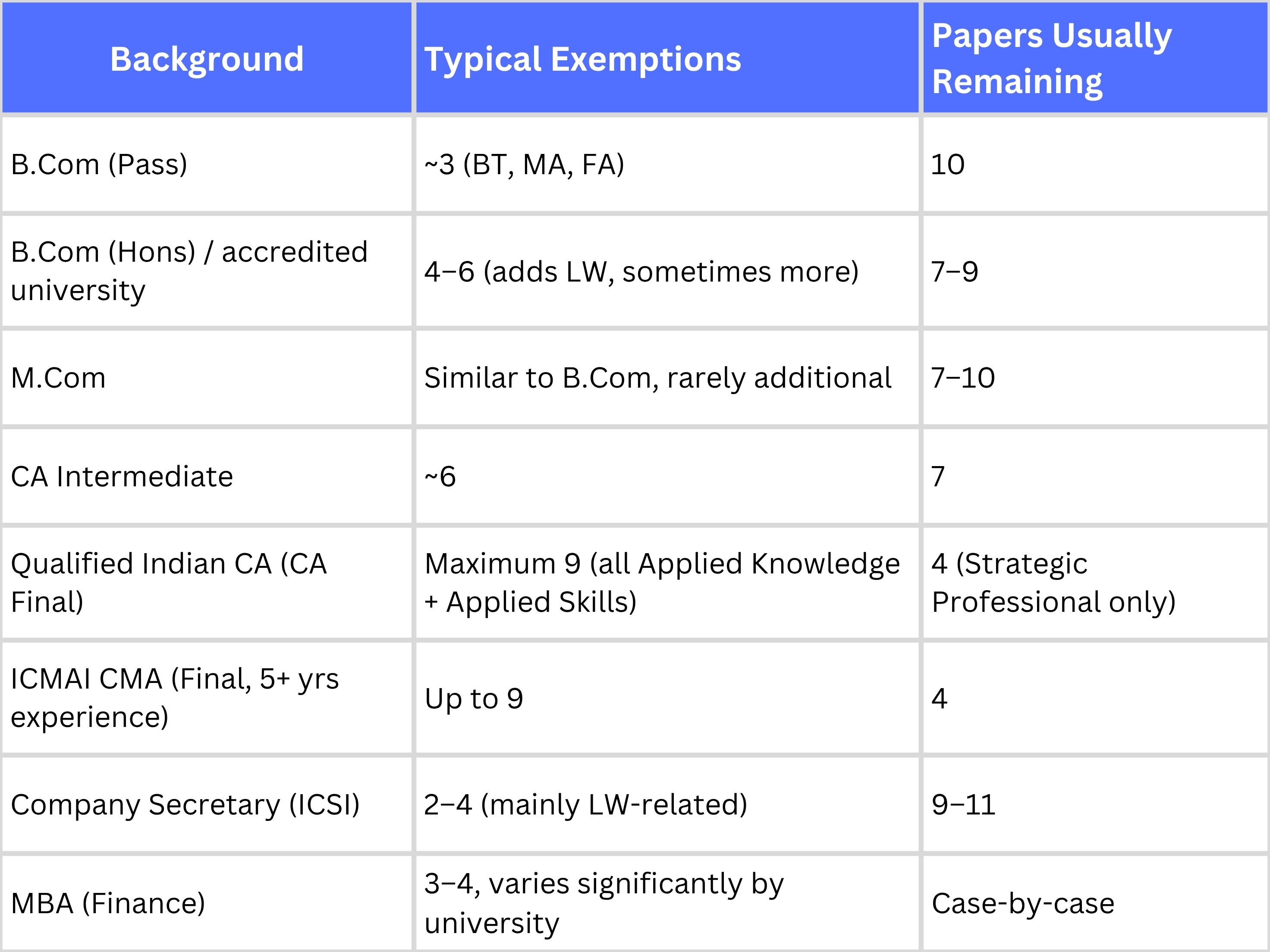
Exemption count depends heavily on your specific university's accredited syllabus, not just your degree title — two students with "the same" B.Com from different colleges can get different results. Always confirm your exact number on ACCA's official Exemptions Calculator before budgeting your timeline; the number shown there is indicative until ACCA reviews your transcripts at registration. Note also that an exemption fee applies per paper skipped — it isn't free.
For a fuller breakdown by qualification — including what happens if you hold more than one qualification, and the most common exemption mistakes students make — see our complete ACCA exemptions guide.
The Best Order to Attempt Papers (This Is Where Most Guides Stop Short)
Technically, ACCA lets you attempt papers within a level in any sequence, and you can book up to 4 papers per session. But "allowed" and "smart" aren't the same thing. A few sequencing principles that actually affect your pass rate:
Finish all of Applied Knowledge before starting Applied Skills. Skipping ahead creates gaps that resurface painfully in FR and PM.
Pair FR before AA. You can't meaningfully audit financial statements you don't yet understand how to construct — attempting AA without FR under your belt is one of the more common reasons students fail it twice.
Take FM before AFM (if you're choosing AFM as an optional). FM's working capital and valuation basics are assumed knowledge in AFM.
Don't book more than 2 Applied Skills papers per sitting. The jump in difficulty from Knowledge to Skills level is steep enough that 3+ papers per session materially increases burnout and fail rates.
Leave SBL for after SBR, not before. SBR builds technical reporting depth that makes SBL's case-study style noticeably more manageable.
Exam Sessions and Realistic Pacing
This is where a lot of guides oversimplify, so here's the distinction that actually matters for planning:
Applied Knowledge papers (BT, MA, FA) are on-demand. You can book and sit these at a local Computer-Based Exam (CBE) centre pretty much whenever you're ready — they're not tied to the four fixed sessions at all.
Applied Skills and Strategic Professional papers are session-based, available only in the four fixed windows — March, June, September, December. These are the ones the 4-per-session, 8-per-year cap actually applies to.
So in practice, your Applied Knowledge level can move as fast as your own preparation allows, while your Applied Skills and Strategic Professional pacing is genuinely constrained by the session calendar — confirmed directly on ACCA's official exam progression rules page.
In practice, realistic full-qualification timelines look like:
Fresh graduates with no exemptions: 2.5–3 years
Students with exemptions: often 1–2 years
Working professionals: typically 1–2 session-based papers per sitting to sustain the pace alongside a job
These numbers only cover the exam side. Your overall ACCA timeline also depends on factors such as exemptions, exam pace and the Practical Experience Requirement. For a broader look at the costs and duration, see our guide to ACCA course fees and duration.
ACCA Exam Fees: What to Budget For
Fees are charged in three separate categories, and it's easy to under-budget if you only account for exam fees:
Initial registration fee — a one-time fee when you first register as an ACCA student
Annual subscription fee — charged every year you remain a registered student, regardless of how many exams you sit that year
Exam entry fees per paper — vary by level (Applied Knowledge papers are cheapest, Strategic Professional papers cost the most) and by how early you book; late entry typically costs significantly more than early entry for the same paper
Exemption fees per paper skipped — charged even though you're not sitting that exam, generally set close to what the exam fee for that paper would have been
Exact figures change periodically and are published in GBP, with India-specific fee guidance available on ACCA's official site; always check the current India fees page before budgeting, rather than relying on a number from an article that may be a few months old.
Passing Criteria
Each paper needs a minimum of 50% to pass, and — importantly — there's no aggregate or ranking system. Every paper is scored independently, which means:
Papers you've passed stay passed, indefinitely
A failed paper can be reattempted on its own without retaking others
There's no compounding penalty for a weak score in one paper if the rest are strong
Which Papers Are Genuinely the Hardest
Wondering how difficult each ACCA paper really is? Our guide to ACCA pass percentages can help you get a clearer picture before you plan your preparation.
Based on recent session pass-rate data, two papers consistently sit at the bottom:
Advanced Audit and Assurance (AAA) and Advanced Performance Management (APM) — both typically land around 38–42%, the lowest of any paper. Both are long-form, case-study based, and test professional judgment under time pressure rather than recall — technique matters as much as knowledge here.
Performance Management (PM) — the hardest paper at Applied Skills level (around 40–45%), numerically intensive with layered decision-making scenarios.
Audit and Assurance (AA) and Advanced Financial Management (AFM) — both moderately difficult (43–46%), requiring applied judgment over memorisation.
Strategic Business Reporting (SBR) — dense IFRS interpretation, typically 40–45%, though slightly more forgiving than AAA/APM.
Pass rates shift slightly session to session, so treat these as difficulty signals for planning your study time, not a fixed ranking.
ACCA Is Changing From 2027 — What It Means for You
Under a programme ACCA calls "Accountancy Redefined," the qualification is being restructured, with the first exams under the new system starting September 2027 (Foundations/Knowledge level exams begin slightly earlier, from July 2027). If you're planning your ACCA journey in 2026, this affects your timeline whether you start now or later.
What's changing:
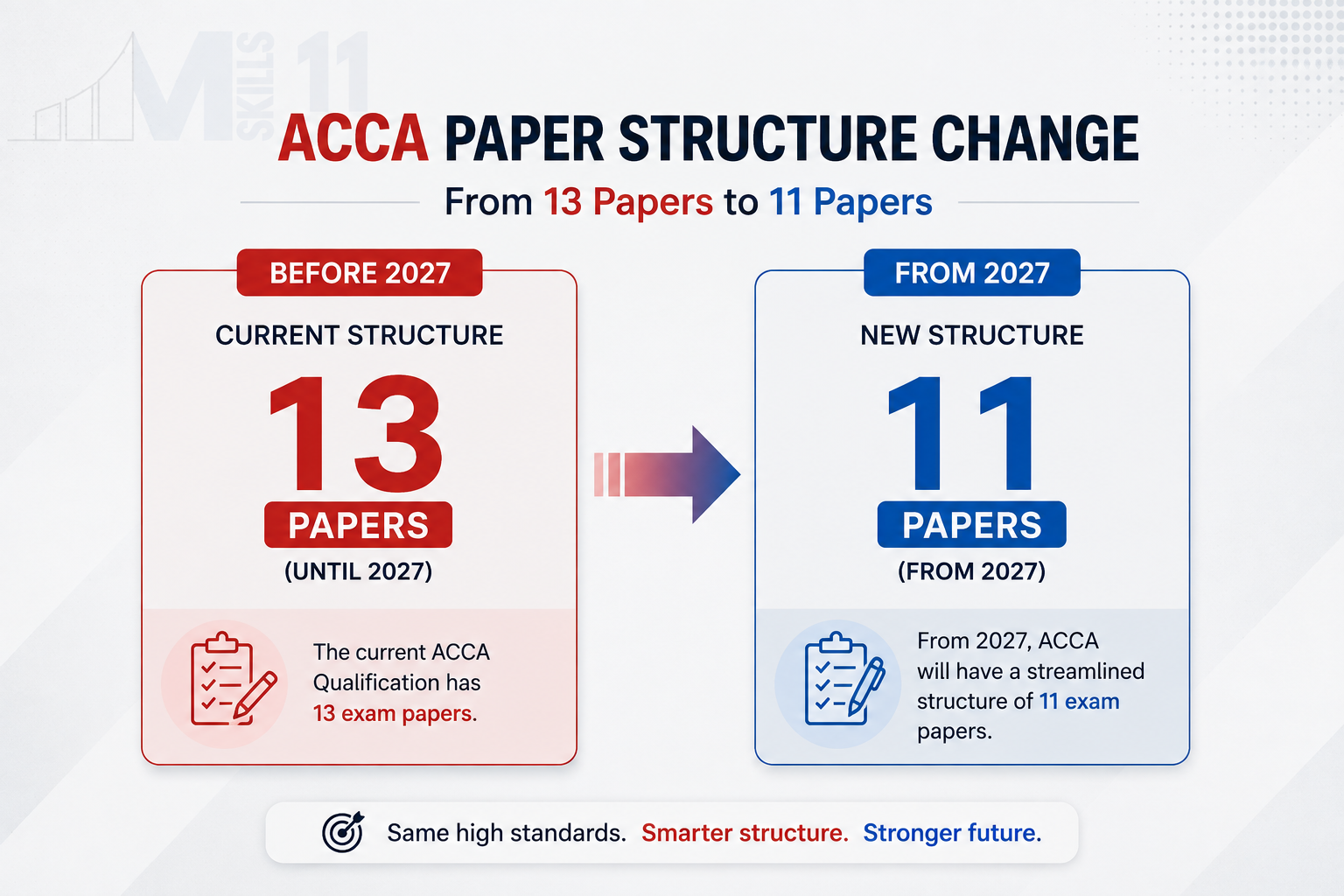
At Strategic Professional, students will take two compulsory papers plus only one optional (down from two optionals today); this changes how many papers in ACCA you'll need to clear, cutting the total count by two, from 13 to 11
New Essential and Optional Employability Modules (EEMs) — non-exam, assessed modules focused on career-readiness, digital skills, and workplace capability
New intermediate awards along the way (e.g., a Higher Diploma and Advanced Diploma in Accounting and Business), plus the option to combine your ACCA studies with a BSc (Hons) Professional Accountancy from the University of London.
What this means for you right now:
FAQs
How many papers in ACCA, exactly?
BT, MA, FA (Applied Knowledge); LW, PM, TX, FR, AA, FM (Applied Skills); SBL, SBR plus 2 of AFM/APM/ATX/AAA (Strategic Professional).
Can a qualified CA convert to ACCA?
Yes — qualified Indian CAs typically receive exemptions for up to 9 papers and generally only need to clear the Strategic Professional level.
How many papers can I attempt per session?
Up to 4, though 1–2 is the more sustainable pace for working professionals.
Do exemptions cost extra?
Yes, exemption fees apply per paper exempted — factor this into your budget alongside exam fees.
Which papers should I avoid combining in one sitting?
Avoid pairing SBR with AFM or SBL in the same session where possible — both are reading- and case-study-heavy, and prepping them simultaneously stretches revision time thin.
What are the minimum qualifications to register for ACCA?
Typically two A-Levels and three GCSEs (or recognised equivalents) including English and Maths. If you don't meet this yet, the Foundations in Accountancy (FIA) route is a valid entry path.
How much does ACCA cost in total?
Total cost depends on registration, annual subscription, per-paper exam fees, and any exemption fees — these vary by how many papers you're exempt from and how early you book each exam. Check ACCA's official India fees page for current figures rather than relying on a fixed number, since these are revised periodically.
Why do some articles or seniors mention 14 ACCA papers instead of 13?
ACCA previously had a 14-paper structure. It was restructured a few years ago. some papers were merged to remove overlapping content, bringing the total down to today's leaner 13-paper qualification. If you come across older content or hear seniors reference "14 papers," that reflects the outdated structure, not the current one.
Conclusion:
Your Next Step: Turning This Into an Actual Study Plan
Here's a guide to choosing the right ACCA books.
Thirteen papers, three levels, and a 2027 structure change on the horizon on paper, ACCA can look like a long runway. In practice, most of that complexity disappears once two things are locked in: your exact exemption count and a sensible paper sequence that doesn't stack difficulty against you (Applied Knowledge fully cleared before Applied Skills, FR before AA, FM before AFM, SBR before SBL).
Where most students lose time isn't the exams themselves — it's guessing at exemptions, misordering papers, or booking three Applied Skills papers in one session out of impatience. A structured course path fixes exactly this: your exemptions get confirmed against your actual transcript (not a generic table), your paper sequence is planned around your background and working hours, and your session-by-session pacing is mapped out from day one instead of decided reactively every three months.
We hope your doubt is clear regarding "how many papers in ACCA?"
Get your exemptions assessed, a paper-wise study sequence built around your background, and faculty support through every session so you're following a plan, not just a papers list.