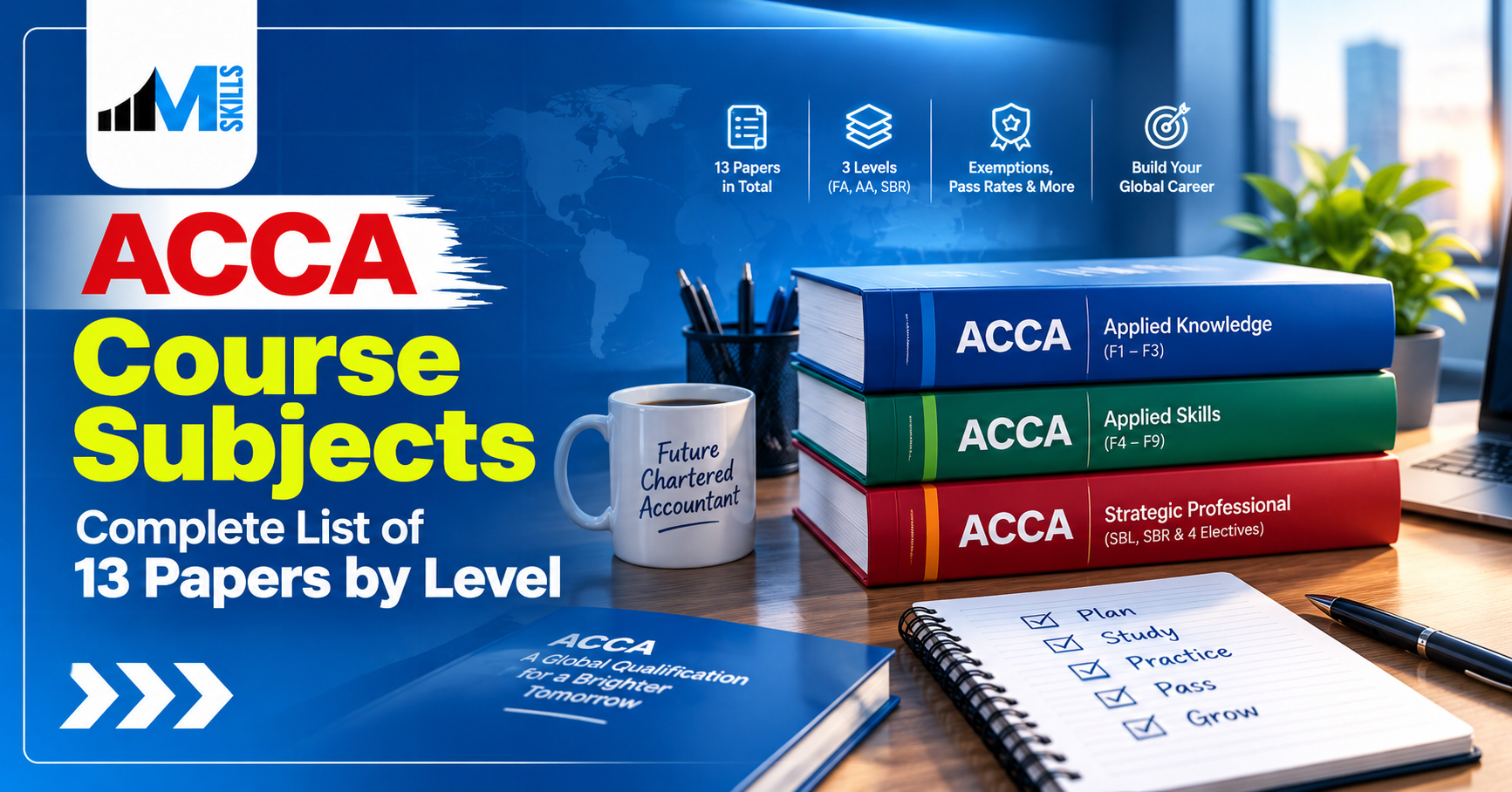
The ACCA course subjects are divided into three levels. Applied Knowledge introduces the fundamentals of business, accounting and management accounting. Applied Skills develops technical knowledge across areas such as law, taxation, financial reporting, audit and financial management. Strategic Professional focuses on advanced reporting, leadership and specialist areas.
| ACCA Level | Subjects | Paper Codes | Number of Exams |
|---|
| Applied Knowledge | Business and Technology, Management Accounting, Financial Accounting | BT, MA, FA | 3 |
| Applied Skills | Corporate and Business Law, Performance Management, Taxation, Financial Reporting, Audit and Assurance, Financial Management | LW, PM, TX, FR, AA, FM | 6 |
| Strategic Professional | Strategic Business Leader, Strategic Business Reporting + 2 Options | SBL, SBR + 2 Options | 4 |
The Strategic Professional level has two compulsory Essentials papers and four Options from which students select two. Therefore, while four Strategic Professional exams are required, students do not take all four Options.
Applied Knowledge Subjects
Applied Knowledge is the first level of the current ACCA qualification. It gives students a foundation in business, accounting and management accounting before they move into more technical subjects.
| Paper | Code | What It Covers |
|---|
| Business and Technology | BT | Business structures, governance, technology, ethics and the wider business environment. |
| Management Accounting | MA | Cost accounting, budgeting, planning, performance measurement and management decision-making. |
| Financial Accounting | FA | Accounting principles, recording transactions and preparation of financial statements. |
Applied Skills Subjects
Applied Skills builds on the foundation created at Applied Knowledge. These papers require a stronger understanding of technical accounting and finance concepts and their practical application.
| Paper | Code | What It Covers |
|---|
| Corporate and Business Law | LW | Legal systems, contracts, company law and the legal environment affecting businesses. |
| Performance Management | PM | Planning, budgeting, performance measurement, cost management and decision-making. |
| Taxation | TX | Tax principles and the application of tax rules in relevant scenarios. |
| Financial Reporting | FR | Financial statements, accounting standards and interpretation of financial information. |
| Audit and Assurance | AA | Audit planning, risk assessment, internal controls, audit evidence and assurance procedures. |
| Financial Management | FM | Investment decisions, financing, working capital and financial risk management. |
These six papers form the core technical stage of the qualification. The subjects cover different areas of accounting and finance, giving students a broader professional foundation before Strategic Professional.
Here you can learn full details about ACCA course details.
Strategic Professional Subjects
Strategic Professional is the final level of the current ACCA qualification. It focuses on advanced technical knowledge, professional judgement, leadership and strategic decision-making.
Strategic Professional Essentials
Students must complete both of the following Essentials papers.
| Paper | Code | Focus |
|---|
| Strategic Business Leader | SBL | Leadership, strategy, professional skills, governance and decision-making in business scenarios. |
| Strategic Business Reporting | SBR | Advanced financial reporting, analysis, interpretation and professional judgement. |
Strategic Professional Options
Students choose two Options from the following four papers.
| Option Paper | Code | Focus |
|---|
| Advanced Financial Management | AFM | Advanced financial management, investment decisions, financing and risk. |
| Advanced Performance Management | APM | Advanced performance measurement, strategic planning and performance management. |
| Advanced Taxation | ATX | Advanced taxation and application of tax principles in complex scenarios. |
| Advanced Audit and Assurance | AAA | Advanced audit, assurance, professional judgement and ethical considerations. |
Important: Strategic Professional requires SBL and SBR plus two Options. You do not need to take all four Options.
ACCA Subjects Difficulty and Pass Rates
Difficulty varies by paper and by a student's background, preparation and familiarity with the subject. Pass rates can provide useful evidence when comparing papers, but they should not be treated as the only measure of difficulty.
The official ACCA pass rates for the June 2026 sitting show how performance varied across the current papers.
| Paper | June 2026 Pass Rate |
|---|
| BT - Business and Technology | 89% |
| FA - Financial Accounting | 71% |
| MA - Management Accounting | 65% |
| LW - Corporate and Business Law | 82% |
| TX - Taxation | 55% |
| FR - Financial Reporting | 52% |
| PM - Performance Management | 41% |
| FM - Financial Management | 48% |
| AA - Audit and Assurance | 47% |
| SBL - Strategic Business Leader | 51% |
| SBR - Strategic Business Reporting | 47% |
| AFM - Advanced Financial Management | 47% |
| APM - Advanced Performance Management | 42% |
| ATX - Advanced Taxation | 47% |
| AAA - Advanced Audit and Assurance | 39% |
Based on the June 2026 figures, AAA had the lowest pass rate among these papers at 39%, while BT recorded the highest at 89%. This does not mean one paper is automatically harder for every student, but it provides useful context when assessing paper-level difficulty.
ACCA Exemptions
ACCA exemptions can reduce the number of exams you need to take if your previous qualifications cover relevant parts of the ACCA syllabus. Exemptions depend on your previous qualification, institution and other relevant details.
For a detailed explanation of eligibility and how exemptions work, read our guide on what are ACCA exemptions.
ACCA states that exemptions may be available from Foundation level and the nine Applied Knowledge and Applied Skills exams. There are no exemptions from Strategic Professional exams, and work experience does not provide exemptions.
Because exemption eligibility varies between students, use the official ACCA Exemptions Calculator rather than relying on a fixed exemption promise.
Check your exemptions using the official ACCA Exemptions Calculator
ACCA Exam Attempts and Completion
ACCA allows students to progress through the qualification by completing exams in the relevant module order. Students can take a maximum of four exams in a single exam cycle and a maximum of eight different exams in one calendar year.
👉Explore the complete guide to ACCA course fees
Once a student passes their first Strategic Professional exam, the remaining Strategic Professional exams must be completed within seven years. Earlier passes at Foundations, Applied Knowledge and Applied Skills do not expire under this rule.
Remember: Your actual completion time depends on exemptions, exam attempts, study pace, exam planning and the amount of relevant practical experience you complete alongside your exams.
EPSM and Practical Experience Requirement
Completing the ACCA exams is only part of becoming an ACCA member. Students also need to complete the Ethics and Professional Skills Module (EPSM) and the Practical Experience Requirement (PER).
The PER requires 36 months of relevant supervised work experience along with the required performance objectives. This practical component helps students demonstrate how they apply their technical knowledge and professional skills in the workplace.
ACCA 2027 Changes
ACCA is redesigning its qualification structure for 2027. The current Applied Skills and Strategic Professional exams have their final sitting in June 2027, while the first redesigned Expertise and Strategic Professional exams are scheduled from September 2027. Knowledge exams move to the redesigned structure from July 2027.
Under the redesigned qualification, Applied Knowledge maps to Knowledge, Applied Skills maps to Expertise and Strategic Professional continues as the final level. Students planning their exam schedule should therefore check the official ACCA transition guidance for the latest rules applicable to their situation.
Check the official ACCA qualification changes for 2027
How to Prepare for ACCA Subjects
Preparing for ACCA subjects requires a structured approach rather than simply reading the syllabus. Start by understanding the exam format and learning outcomes for your paper.
Choose the right study material with our guide to the best ACCA books.
1. Understand the syllabus
Break the syllabus into manageable topics and identify the areas that carry greater importance in your preparation. Understanding the syllabus first makes it easier to build a realistic study schedule.
2. Practise exam-style questions
Regular question practice helps you understand how ACCA tests application, analysis and professional judgement. Use practice questions, mock exams and past resources where appropriate.
3. Review your mistakes
Do not only count correct answers. Review incorrect answers and identify whether the problem was conceptual understanding, calculation, interpretation or time management.
4. Plan your exam attempts
Consider the difficulty of the papers you are taking together, your available study time and the ACCA exam cycle. A realistic combination is generally more useful than simply trying to take as many papers as possible.
If you prefer structured preparation with expert guidance and exam-focused support, explore our ACCA Coaching Classes to learn more about the course and available learning support.
FAQs
1. What are the 13 subjects in ACCA?
The current ACCA qualification requires 13 exams: 3 Applied Knowledge papers, 6 Applied Skills papers and 4 Strategic Professional papers. At Strategic Professional, students complete SBL and SBR plus two Options from AFM, APM, ATX and AAA.
2. How many levels are there in ACCA?
The current ACCA qualification has three levels: Applied Knowledge, Applied Skills and Strategic Professional.
3. How many attempts are allowed for ACCA?
ACCA does not set a simple lifetime limit on the number of times you can retake a paper. However, exam-entry and progression limits apply, including a maximum of four exams per exam cycle and eight different exams in a calendar year. A seven-year completion rule applies to the Strategic Professional exams after the first Strategic Professional pass.
4. Can ACCA be completed in one year?
Completion time depends on factors such as exemptions, previous knowledge, study time, exam attempts and practical experience. Students with substantial exemptions may have fewer exams to complete, but completing the full qualification in one year would require an exceptionally intensive schedule and is not a standard expectation.
5. Can I pass ACCA in the first attempt?
Yes. Passing papers on the first attempt is possible with consistent preparation, sufficient practice and a clear understanding of the exam requirements. However, individual results vary by paper and student.
6. Which ACCA subject is the toughest?
There is no universally toughest ACCA subject because difficulty is subjective. However, papers with lower recent pass rates can provide useful evidence when comparing difficulty. In June 2026, AAA had a 39% pass rate, followed by APM at 42% and PM at 41%.
7. What are ACCA paper subjects?
ACCA paper subjects are the individual exams that make up the qualification. They include BT, MA, FA, LW, PM, TX, FR, AA, FM, SBL, SBR and two selected Strategic Professional Options.
8. How many Strategic Professional Options do I have to take?
You must take two Strategic Professional Options. You choose them from Advanced Financial Management, Advanced Performance Management, Advanced Taxation and Advanced Audit and Assurance.
9. Are ACCA exemptions available in India?
Yes, exemptions can be available depending on your previous qualification and other details. ACCA recommends checking your individual eligibility through its official Exemptions Calculator.
Conclusion
The ACCA course subjects are structured to take students from fundamental accounting and business knowledge to advanced technical and strategic skills. The current qualification has three levels: Applied Knowledge, Applied Skills and Strategic Professional.
Knowing the complete ACCA subjects list helps you understand the progression of the qualification, compare papers, plan your exam attempts and identify where exemptions may apply.
Before making decisions about exemptions, exam progression, pass rates or the 2027 qualification transition, always check the latest information from ACCA Global because qualification rules and exam structures can change.
Visit ACCA Global for the latest qualification information