Step 1: Understand What UI and UX Design Are Used For
Before learning tools or design techniques, it is important to understand the difference between UI and UX design.
UX design focuses on solving user problems. UX designers research users, understand their needs, and design experiences that are convenient and drive user retention.
UI design focuses on how the product looks. UI designers work with layouts, color systems, icons, typography, and visual elements to make the experience of users better.
Almost all projects require UI and UX to work together. A UX designer plans the structure and flow of an app. A UI designer ensures it looks visually appealing and consistent.
Understanding this difference will help you decide whether you want to specialize in UX, UI, or become a designer who is well-versed in both.
Looking for a high paying jobs in the creative field, then the UI UX Design Course is going to be the one you need to follow.
Step 2: Learn the Fundamentals of Design Principles well
Good design is not random. It follows certain sets of principles that make websites and applications convenient and visually attractive.
Some important design principles include:
Hierarchy
Design elements should be placed in such a way that the most important aspects come to the attention of the users first.
Consistency
Buttons, UI colors, and layouts should remain consistent on the websites and applications.
Alignment
The alignment should be such that all of the elements are properly structured and do not appear random.
Contrast
Contrast in UI/UX design means making elements look different from each other so users can easily notice and understand them. What should I look at first? What is clickable? What is important and what is less important? These are the questions that are answered with a design that has contrast.
Whitespace
Empty space improves readability and reduces clutter. Understanding these fundamentals will make your designs cleaner and easier for users to navigate.
Step 3: Explore User Research Well
UI/UX design always begins with understanding the user. This process is called user research. User research as the name suggests, is the study of how the target audience will react to designs and the layout. It helps designers identify what users need and what problems they face.
Common user research methods include:
For example,for a food delivery app, you need to understand how users search for restaurants, place orders, and track deliveries. Research ensures that design decisions are based on real users and their behaviour rather than some random assumption.
Visit here: UX Laws: 15 UX Laws For Creating Winning Designs
Step 4: Learn Information Architecture
Information architecture focuses on organizing content so that users can easily find what they need. This means structuring website pages, organizing menus, and collating related content, among others. Designers often create site maps and user flows during this stage.
For example, in an e-commerce website, products must be categorized logically so users can browse easily. If information architecture is confusing, users will leave the website quickly.
If you’re looking to enroll in professional online courses, then IIM SKILLS is here to offer the best courses with placement. Here are:
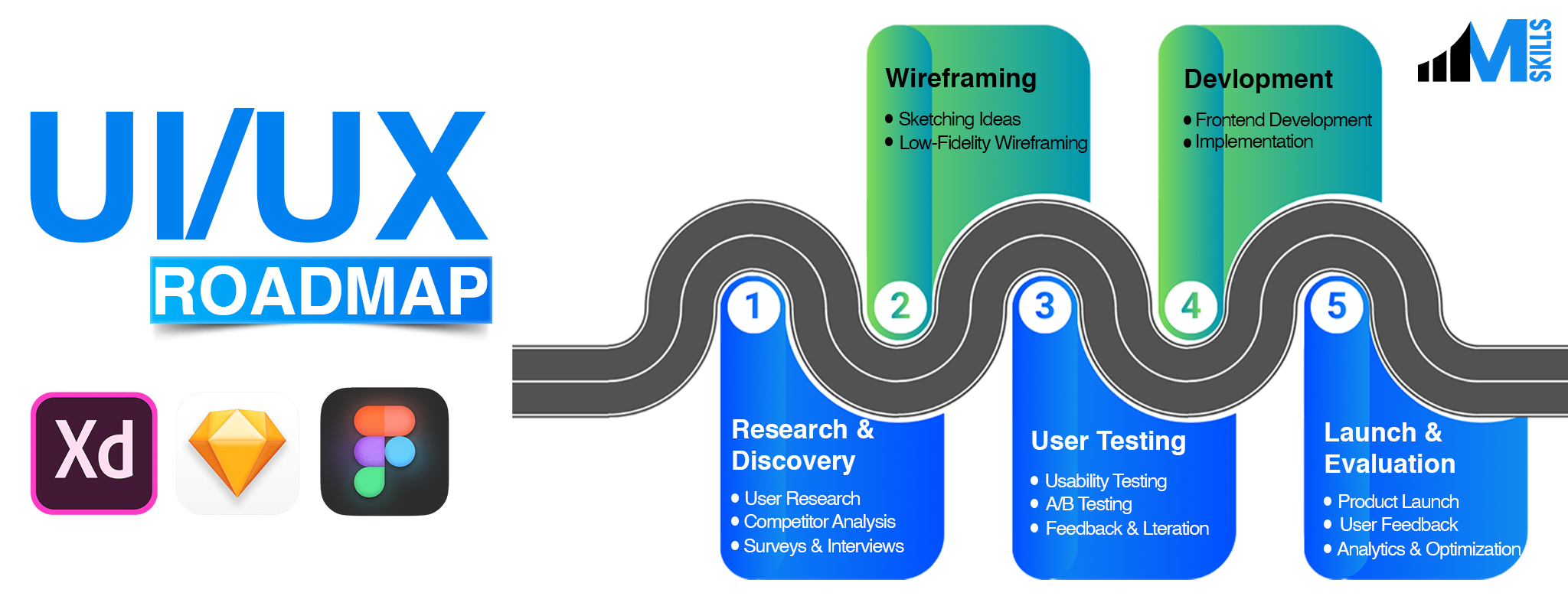
Step 5: Wireframing
Wireframing is one of the most important skills for UX designers who want to excel in the field of UX Design.
The two types of wireframes are as follows:
- Low-fidelity wireframes
- High-fidelity wireframes
If you have some doubts about “is ui ux design a good career?” Then read our blog, which helps you in this journey. Our UI UX Roadmap explains why this is one of the best careers for creative people.
Step 6: Visual Design
Once the structure is clear, designers start working on the visual design. UI design also prioritizes maintaining a consistent design across websites and applications.
UI design components can be delineated as follows:
- Color palettes
- Typography
- Icons and buttons
- Layouts and grids
- Card and form design
If you’re looking to upgrade your skills in 2026, then here are some IIM SKILLS Master Courses you should go for:
Step 7: Learn Prototyping
Prototypes are simple versions of a design that show how the final thing will work. They help designers to test things like clicking buttons and moving between screens. Also, filling out forms is an important part of prototyping.
Step 8: Usability Testing
Usability testing helps designers understand whether a design is easy to use. During testing, real users use the prototype while designers watch how they behave. It helps to find confusing parts and see if users can complete tasks easily or not. It also checks how satisfied the users feel.
Also Check: UX Design Process: 10 Steps Designers Need to Know
Step 9: Build a Portfolio
A great portfolio is the most important factor for UI UX design jobs. A good portfolio is usually includes case studies so that employers understand your skills better.
Your portfolio should include the following:
- Case studies of design projects
- Problem statements
- Research methods
- Wireframes
- Prototypes
- Final UI designs
Step 10: Stay Updated
As a designer, you should keep learning new UI UX tools, trends, and technologies. You should continue redesigning applications and websites that already exist. Enroll for design challenges.
Study successful product design and read UX case studies & UX Laws. The more projects you practice, the more you develop conviction in your skills as a designer.
If you’re looking for UI UX Course near you, then IIM SKILLS is here to offer AI-infused UI UX Design Courses in different cities:
What are the trending UI UX Tools that one should learn?
Figma, Adobe XD, Sketch, Miro, and Notion are some tools that you should learn as a UX UI designer. For the latest UI UX Trends in industries, one should give a shot to learn these tools:
Which UI/UX course is Best for 2026?
1. IIM SKILLS
IIM SKILLS is a leading ed-tech company offering a plethora of professional courses. The UI/UX Design courses available are ideal for beginners and experts and come with strong career support. Mentor support is great, and you have exemplary post-course support as well.
Course Details
UI/UX Design Master Course
UI/UX Full Stack Course
Features
- Duration - 4–6 months depending on the course you choose
- Mode- Live online classes
- Tools: Figma, Notion, AI tools, Framer, and more
- Internships
- Placement assistance
- Portfolio building
- 1:1 mentorship
- Mock interviews
2. Simplilearn
Simplilearn in association with IIT Bangalore, has a UI/UX program. You have a combined advantage of strong certification and a structured curriculum.
Features
- Duration is 3-5 months
- Online bootcamp
- Portfolio projects
- Masterclass
- Career support
3. Karmick Institute
Karmick Institute has a UI/UX Design and Web Design Course combined. It is backed by IIT Patna. The course includes UI/UX and basic coding skills to give you a total understanding of the course.
Features
Duration - 6 months
You have online, offline and hybrid options
If you’re looking to know more about UI UX Design, then you should check out our other blogs:
FAQs About the UI/UX Designer Roadmap
1. Is a design qualification mandatory for UI/UX Designers in 2026?
No, not at all. Many successful UI/UX designers come from varied backgrounds, such as marketing or content writing.
2. How long does it take to successfully become a UI/UX designer?
For beginners, it usually takes 3-6 months to learn the basics. However, you have to continuously learn what's new in the UI UX domain to keep yourself abreast of new developments.
3. Which tool should beginners learn at the beginning for UI/UX design?
Most beginners start with Figma because it is easy to learn and widely used by design teams.
4. Is coding necessary for UI/UX designers?
Coding is not mandatory at all. But basic knowledge of HTML, CSS, and front-end development can help you progress in your career more easily.
5. What should a beginner with a UI/UX portfolio have?
As a beginner, you should have at least 5 case studies that show your design process.
Conclusion
UI/UX design is a great career and is only growing in demand. You do not need a special design degree to become a designer in 2026. What really matters is learning the basics and practicing again and again.
You should also make a portfolio to show your work and how you solve problems. You can take a good course that fits what you want to learn. If you have any doubts, you can check the UI UX Roadmap, which will help you to understand in high paying job.
If you’re someone who’s looking to upskill, then IIM SKILLS is the right platform to learn the best online courses with Gen AI.