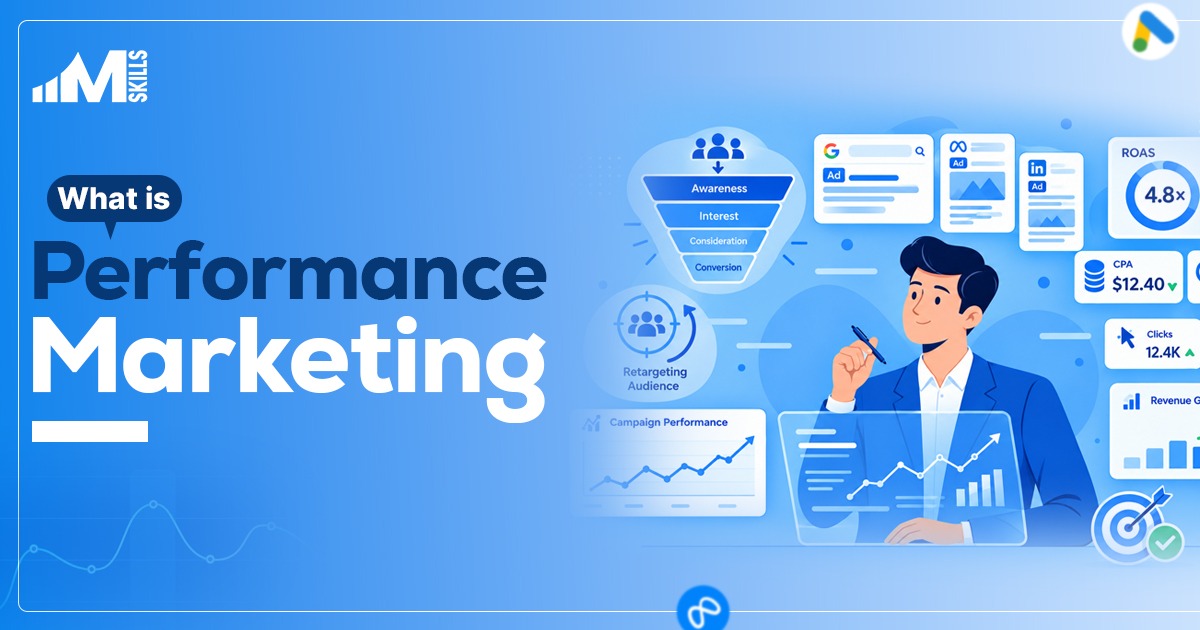
Performance marketing is a result-driven digital marketing strategy that companies use to advertise their products or services. Advertisers use different marketing channels such as search engines, social media, and display ads to promote products and only pay when a specific action is achieved. The specific action can be a click, download, lead, form submission, a newsletter sign-up, or a sale.
Unlike traditional marketing, where advertisers pay an upfront amount with no guarantee of a measurable outcome, performance marketing pays for actions. Advertisers promote their products or services through publishers, agencies, and affiliates and pay them only when a measurable result/action is achieved.
For a more detailed overview, you can also explore our comprehensive guide to performance marketing .
.
Performance marketing involves a few steps: advertisers understand their goals, select appropriate channels, create ads, launch and track campaigns, and optimize for better results.
Businesses can use different performance-based marketing strategies depending on their goals, target audience, budget, and conversion objectives.
Let’s learn about these steps in detail.
Step 1: Set Campaign Goals and Target Audience
When planning a performance marketing campaign, the most important aspect is the objectives. That is what the advertiser wants to achieve through the campaign and who their target audience is. The campaign goals or objectives can be:
Step 2: Select Channel
Advertisers then need to select the appropriate channels based on their campaign goals and target audience. The popular channels are:
Search Engines
Social Media Platforms
Affiliate Platforms
Email Marketing
Influencer Marketing
Display Ads
Step 3: Create the Ads
Based on the selected marketing channels, advertisers need to create compelling ad content. Ads should be visually appealing, include proper CTAs, attract customers, and convey the product value.
Step 4: Launch and Track
Advertisers launch the campaign on the decided channels and collect data to track performance. They use tools and tracking platforms, including Google Analytics, Meta Ads Manager, and others, to continuously track user actions and analyze behavior. This way, advertisers measure the campaign’s effectiveness.
Step 5: Test and Optimize
Next, they analyze the campaign performance data and use techniques like A/B testing to find the better-performing versions of similar Ads. Advertisers optimize or refine ads based on data to improve performance and results.
Learn how performance marketing differs from brand marketing and affiliate marketing based on definition, channels, and other aspects.
Definition
Performance marketing
A result-focused strategy where companies pay for performance or actions.
Affiliate marketing
Companies pay affiliates per action, such as a sale or lead.
Brand marketing
A strategy used to build long-term brand authority.
Purpose
Performance marketing
Achieve quick, measurable results.
Affiliate marketing
Promote products through bloggers, influencers, and other partners.
Brand marketing
Build trust and a strong brand presence.
Who can handle
Performance marketing
Internal teams or external agencies and publishers.
Affiliate marketing
Affiliates such as influencers, paid media, or bloggers.
Brand marketing
Internal teams, including brand managers.
Channels
Performance marketing
Search engine, social media, email, affiliate marketing.
Affiliate marketing
Affiliate platforms.
Brand marketing
Television, content marketing, event marketing, and more.
Pay structure
Performance marketing
Before or after conversion, depending on the model.
Affiliate marketing
Once a desired action happens, such as a sale or download.
Brand marketing
Requires upfront payments.
Performance marketing is a results-driven approach within digital marketing where campaigns are measured against specific actions such as clicks, leads, sales, or conversions.
Digital marketing is broader and includes activities such as SEO, content marketing, social media, email marketing, branding, and paid advertising.
For a broader understanding of the digital marketing ecosystem, explore the different types of digital marketing used by businesses across various channels and objectives.
In simple terms, performance marketing focuses on measurable outcomes, while digital marketing covers the wider online marketing ecosystem. Performance marketing can therefore be considered a part of digital marketing rather than a completely separate field.
Performance marketing primarily focuses on measurable campaign outcomes such as leads, conversions, sales, cost per acquisition (CPA), and return on ad spend (ROAS).
Growth marketing takes a broader approach and uses experimentation across the entire customer journey, including acquisition, activation, retention, and revenue.
The main difference is the scope. Performance marketing focuses on improving the efficiency and results of specific marketing campaigns, while growth marketing focuses on finding opportunities to grow the overall business.
For example, a performance marketer may optimize an advertising campaign to reduce CPA, while a growth marketer may test landing pages, onboarding, retention strategies, pricing, and acquisition channels to improve overall business growth.
In performance marketing, advertisers use different channels to attract users and advertise products or services.
For a broader overview of paid digital advertising formats, explore these types of online advertising used by businesses to reach and convert their target audiences.
These channels are discussed below:
Search Engine Marketing
Search Engine Marketing is a paid advertising strategy that helps companies showcase their products and services at the top or bottom of the search results page. Companies launch ads for specific keywords on search engines such as Google, Bing, and Yahoo to attract customers to their products/services.
In social media marketing, advertisers place ads on platforms such as Facebook, Instagram, X, and Snapchat to reach their target audience based on demographics, location, and interests.
Affiliate Marketing
Affiliate Marketing is a performance marketing strategy where advertisers promote their products or services through external partners such as bloggers, influencers, or paid media. Affiliates provide product links to their audience and earn a commission when users click on them and perform the desired action.
Email Marketing
Email marketing is a direct marketing method where advertisers build a list of user email addresses and send direct emails. Companies promote their products, special offers, and generate leads through these emails. Advertisers can also track the click-through rates and conversion rates.
Native Advertising
Native Advertising allows companies to naturally blend their ads into the feed of the platform they are being advertised on. These are paid ads that appear in the form of sponsored posts and videos on social media platforms or among watch next and recommendations.
Content Marketing
Content Marketing involves creating useful content and sharing it with audiences on channels such as blogs, emails, videos, or social media posts. The purpose is to attract users, create interest, build brand awareness, and eventually convert them into customers.
Influencer Marketing
In influencer marketing, advertisers connect with influencers to promote their products or services. Companies approach influencers with a niche audience similar to theirs and provide them with affiliate links. Influencers earn commission based on the number of sales, leads, or other desired actions generated through their link.
Display Ads
In display advertising, visual ads are posted across several platforms such as websites, apps, and social media to attract users and achieve desired actions. These ads are usually banners, images, animations, or videos.
AI and automation are becoming increasingly important in performance marketing in 2026.
For a broader understanding of how AI is transforming the marketing landscape, explore our guide to AI in digital marketing.
Advertising platforms use AI to automate tasks such as bidding, audience targeting, budget allocation, and campaign optimization. These capabilities help advertisers respond to performance signals and optimize campaigns more efficiently.
For performance marketers, this means the role is shifting from manually managing every campaign setting toward setting clear goals, providing quality data and creative assets, monitoring results, and making strategic decisions. AI can automate many execution-level tasks, but marketers still need to manage the offer, messaging, measurement, budget, and overall campaign strategy.
In 2026, understanding AI-powered advertising tools alongside fundamentals such as conversion tracking, audience research, creative testing, CPA, and ROAS can help performance marketers build and optimize more effective campaigns.
Performance marketers build strategies based on the business type, their goals, channel choices, and other factors. So no one strategy works for all, but the common steps involved are:
1. Determine The Goal
When you build a performance strategy, you should first know why you are building it. Identify what you aim to achieve through this performance marketing campaign. It can be leads, sales, newsletter sign-ups, or downloads.
For example: If you are an institute, your campaign goal might be to increase the number of course enrollments for a newly launched course.
2. Know Your Target Audience
After identifying the “why” behind the campaign, determine “who it is for.” Identify your target audience and buyer personas, including who they are, where they spend their time, what interests them, and what they need. Use your previous data to find your target audience.
Continuing the same example, your newly launched course might have an ideal customer who is a software engineer with 1-2 years of experience and wishes to advance into Agentic AI. The more specific you are about your ideal customer, the better results you’ll get.
3. Select the Channel and Budget
Next, select the channel and promote your product or service where your ideal customers are. Select the performance marketing channel that best suits your target audience and goals. Start with 2-3 channels and allocate the highest budget to the channel that has generated the most leads or sales for your business in the past.
Using the same example, to target software engineering professionals with 1-2 years of experience, you might have to run ads on search engines like Google and social media platforms like LinkedIn and Instagram.
4. Set Your KPIs
Based on your campaign objectives, determine the key performance indicators such as cost per click (CPC), cost per acquisition (CPA), Return on Ad Spend (ROAS), and others. Identify the performance metrics from this campaign that are most valuable to your business.
5. Build Ads and Start Your Campaign
Create conversion-focused ads that directly address the main objectives and have a clear call to action. Avoid anything that can distract users from the desired action. Make the action clear and easy to understand for users.
Monitor performance across selected channels continuously and analyze the data to determine the campaign impact. Determine which channels are working best or which keywords have high conversion rates on Google. Track metrics and optimize for better performance.
7. Test and Optimize
Test slightly different versions of the same ad and see which ones are working better. Analyze behaviour to identify campaign shortcomings. Suppose users are leaving the form incomplete;Suppose users are leaving the form incomplete; there might be problems such as asking for too much information, unnecessary form fields, or a technical glitch. Optimize the ads and reallocate budgets to improve performance.
Performance marketing involves continuous tracking of campaign performance. But what are those metrics that help evaluate the campaign’s effectiveness? Find out about these key metrics in this section.
Traffic, Cost, and Conversion Metrics
1. Cost Per Click (CPC)
This metric measures the amount of money advertisers pay each time a user clicks on their ad. It is also known as pay-per-click (PPC) advertising.
2. Cost Per Mille (CPM)
CPM refers to the pricing model where advertisers pay money for every 1000 views or impressions on their ads.
3. Cost Per Acquisition (CPA)
CPA refers to the total cost required to acquire a customer. It is usually the amount of money paid for a single completed sale.
4. Click-Through Rate (CTR)
This metric helps advertisers measure how many times a user clicks on their ad after seeing it. It compares clicks versus impressions.
ROI and Value Metrics
1. Return On Ad Spend (ROAS)
This metric shows how much revenue a business generated for the amount they spent on ads.
2. Customer Lifetime Value (CLV/CLTV):
It predicts the average net profit expected from a single sale over the customer’s entire life cycle with the brand.
As most companies plan to increase their budgets for performance marketing, it is important to understand what benefits it provides.
Performance marketing is a growing career option for professionals interested in digital advertising, data analysis, customer acquisition, and measurable business results. Performance marketers typically work with platforms such as Google ads, Meta ads, YouTube, and other paid media channels to generate measurable outcomes such as leads, sales, and conversions.
If you are exploring the broader field beyond performance marketing, learn more about building a career in digital marketing.
Performance marketing salaries in India vary depending on experience, location, company size, platform expertise, and the level of responsibility. Current salary data for Performance Marketing Manager roles in India shows a base-pay range of around ₹7–15 LPA, with an average base pay of approximately ₹10.5 LPA.
For beginners, salaries can vary significantly depending on whether the role is an internship, executive, analyst, or specialist position. As professionals gain experience in campaign strategy, conversion optimization, analytics, and budget management, they can progress into specialist, manager, and senior performance marketing roles.
Some commonly seen career paths include:
Performance Marketing Intern or Trainee
Performance Marketing Executive
Performance Marketing Analyst
Performance Marketing Specialist
Performance Marketing Manager
Senior Performance Marketing Manager
Head of Performance Marketing
Along with platform knowledge, developing strong digital marketing skills can help performance marketers improve campaign strategy, analysis, and overall career growth.
Salary should therefore be viewed as a broad market range rather than a fixed figure. Skills, portfolio quality, campaign experience, and the ability to demonstrate measurable results can have a significant impact on career progression and compensation.
Although performance marketing can be highly effective, some common mistakes, if ignored, can cause damage. Some of these common mistakes are:
Not having a specified target audience and campaign objectives.
Optimizing without having proper data to study.
Using the same ads for a longer period of time without any changes.
Not performing a thorough competitor analysis.
Inconsistent and poor brand messaging.
Websites not optimized for mobile or slower loading times.
Not having proper pixels or tracking tools in place.
With the growing demand for performance marketing, comes the need for structured training. Performance marketing courses are a great option to master result-focused marketing strategies. Some of the best Performance Marketing Courses are offered by:
1. IIM SKILLS
2. Young Urban Project
3. Udemy
4. Growth School
5. NIDE
If you want to develop practical skills in paid advertising, campaign optimization, analytics, and AI-powered performance marketing, consider exploring our Performance Marketing Course.
FAQs
What are some examples of performance marketing?
Influencers promoting a brand and providing a link to their product and earning after users make a purchase or perform a desired action through that link is an example of performance marketing.
Companies posting ads of their products or services on top of search results for particular keywords is another performance marketing example.
Who uses performance marketing?
Anyone who wishes to gain measurable results and wants more control over their advertising budget can use performance marketing. This includes tech companies, e-commerce brands, ed-tech institutions, small businesses, and affiliates.
What is the 3-3-3 rule in marketing?
The 3-3-3 rule is used to help advertisers stay clear with their strategies. Instead of running ads for everyone and everywhere, they stick to three specific audiences, use three main channels, and focus on their three main USPs.
What are the key performance indicators in marketing?
The most important performance indicators in marketing are click-through rate, conversion rate, cost per acquisition, return on investment (ROI), and customer lifetime value.
When is performance marketing the right option?
Performance marketing is the right option when businesses want measurable results and only wish to pay after achieving an action such as a sale, lead, or sign-up. It is also beneficial when you want lower risks, have limited budgets, seek more control, and want quick results.
Does SEO come under performance marketing?
No, SEO doesn’t come under performance marketing. SEO is an organic marketing strategy used to improve search rankings and website traffic.
Conclusion
Now, as competition grows, performance marketing isn’t limited to running paid ads and waiting for results. It is about understanding your goals and target audiences, selecting the right marketing channels, continuously tracking results, and optimizing ads for better results and ROI. If you want to learn how to achieve measurable results for your business or company and are looking for a career in performance marketing, then IIM SKILLS offers a well-designed performance marketing course that covers the industry frameworks, strategies, and tools.